
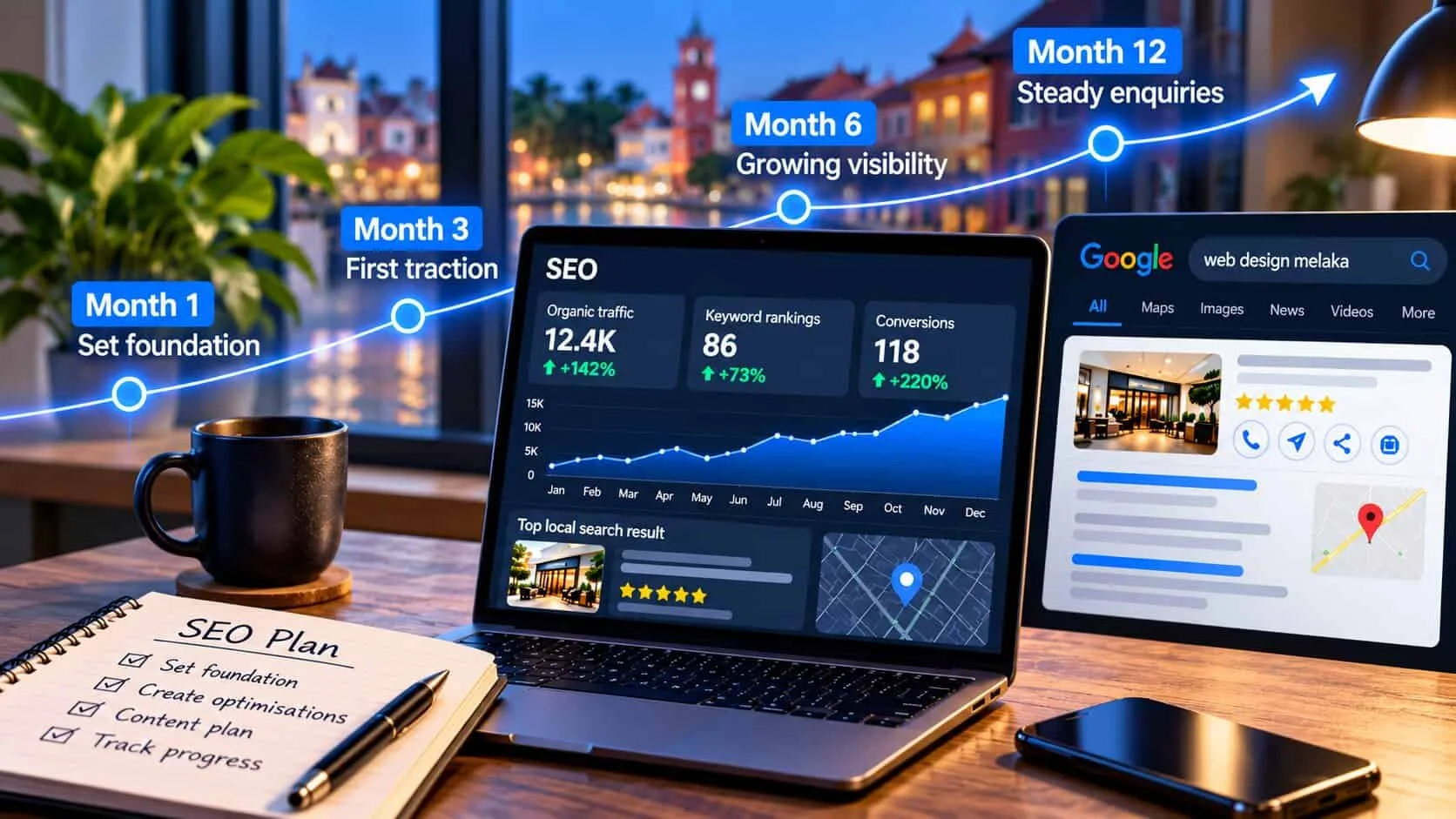
The answer
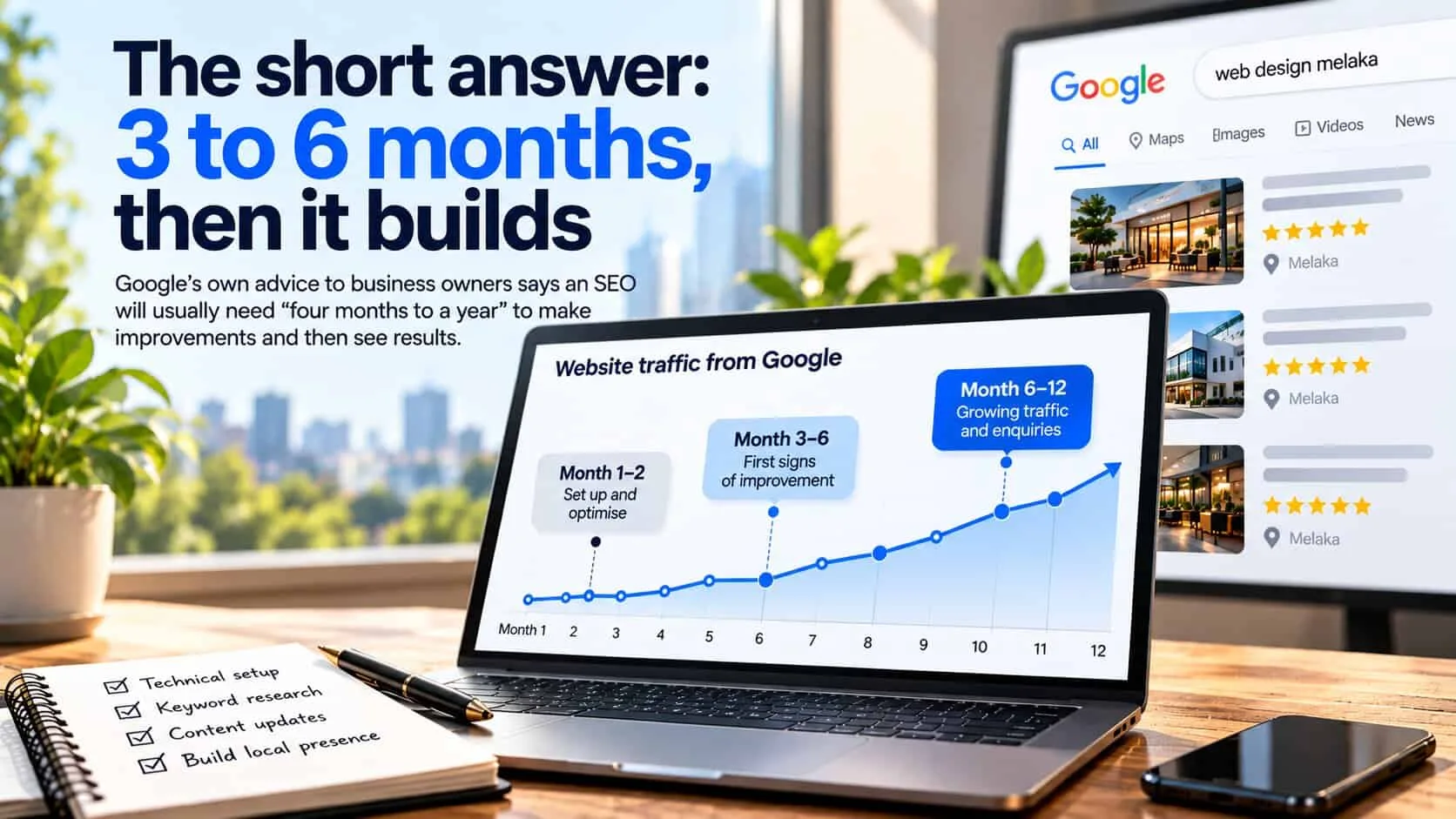
The short answer: 3 to 6 months, then it builds
Google’s own advice to business owners says an SEO will usually need “four months to a year” to make improvements and then see results (Google Search Central). That matches what I see on small business sites.
How long it takes depends most on what people are searching for. A search that names your town and one service is far easier to win than a broad one.
| Type of search | Example | First movement | Steady enquiries |
|---|---|---|---|
| Faster | |||
| Your business name | “Tan Brothers Renovation” | Days to weeks | Right away |
| One service + your town | “roof leak repair Ayer Keroh” | 1–3 months | 3–6 months |
| Typical | |||
| Your main service + city | “renovation contractor Melaka” | 3–6 months | 6–12 months |
| Questions buyers ask | “how much does a kitchen renovation cost” | 3–6 months | 6–12 months |
| Slower | |||
| Broad, national searches | “renovation contractor Malaysia” | 6–12 months | 12 months + |
| Busy “best” searches | “best renovation company KL” | 12 months + | Only with strong links |
Typical ranges for a small business site with the basics fixed. A site with years of history and good links moves faster; a brand-new one may sit at the slow end.
The timeline
What happens month by month
Every site moves at its own pace, but the stages come in the same order. Knowing them stops you from giving up in month two, which is when most owners do.
- 1
Weeks 1–4: Google finds your pages
Submit your sitemap in Google Search Console. Your pages start appearing for your business name. Nothing else yet — that is normal.
- 2
Months 1–3: impressions start, clicks don’t
Google tests your pages for different searches, usually far down at position 40 to 80. You see impressions in Search Console, but almost no clicks.
- 3
Months 3–6: you climb to pages 2 and 3
Specific local searches reach positions 11 to 30. The first clicks arrive from long, specific searches. Your Google Business Profile often brings calls before the website does.
- 4
Months 6–12: page one for your local searches
The pages with the clearest answer reach the top 10 for your service and town. Enquiries become steady instead of lucky.
- 5
Month 12 onwards: it compounds
Each new page starts with more trust than the last. Broader searches become possible, and you depend less on ads.
The factors
What makes SEO faster or slower
You can’t control Google, but you control most of what decides your pace. Seven things make the biggest difference.
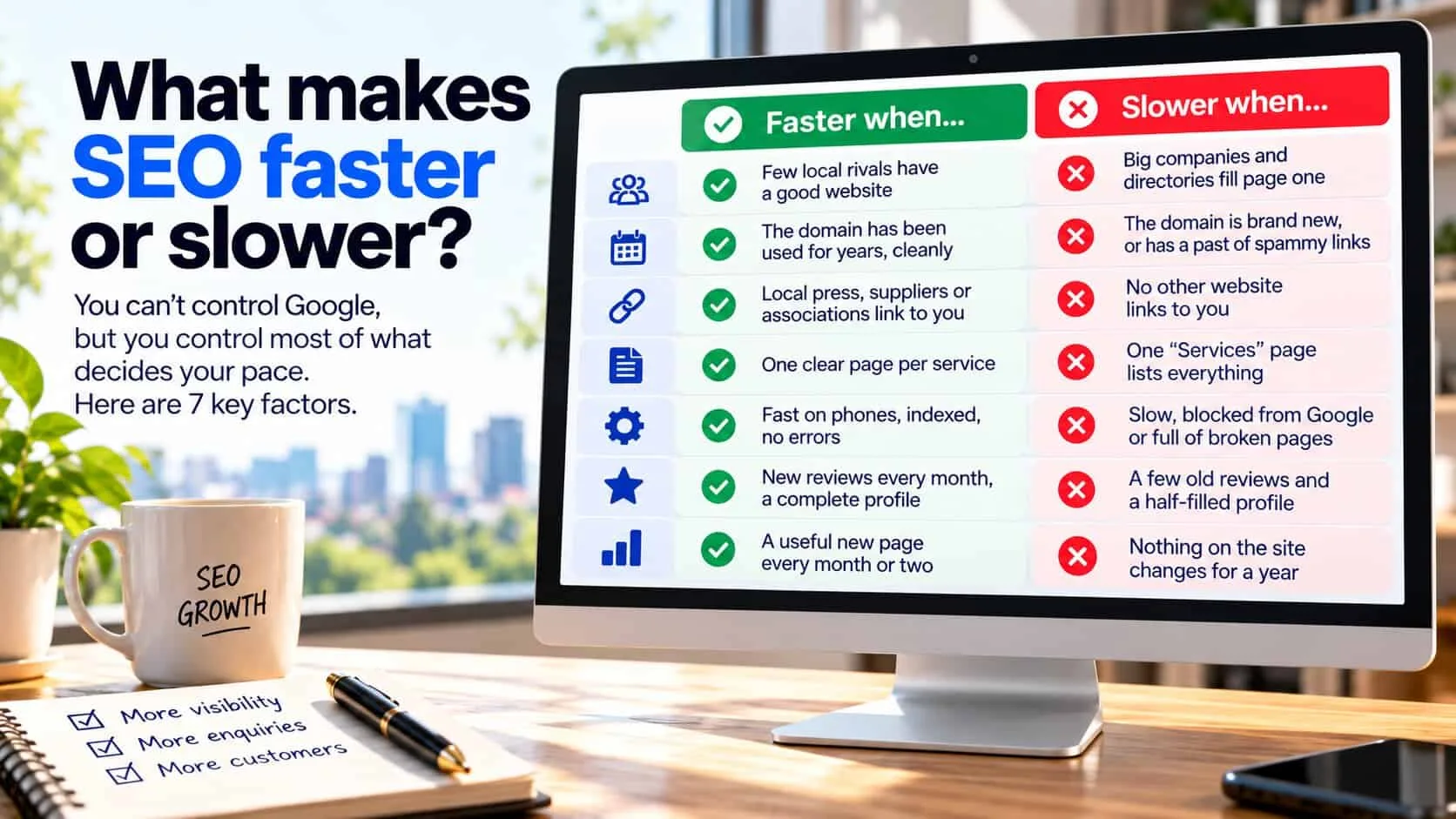
| Factor | Faster when… | Slower when… |
|---|---|---|
| Competition | Few local rivals have a good website | Big companies and directories fill page one |
| Your site’s history | The domain has been used for years, cleanly | The domain is brand new, or has a past of spammy links |
| Links from other sites | Local press, suppliers or associations link to you | No other website links to you |
| Service pages | One clear page per service (how to write one) | One “Services” page lists everything |
| Technical basics | Fast on phones, indexed, no errors | Slow, blocked from Google or full of broken pages (how to check) |
| Reviews and Google profile | New reviews every month, a complete profile (getting reviews) | A few old reviews and a half-filled profile |
| New content | A useful new page every month or two | Nothing on the site changes for a year |
The part you control most is your pages. The part that takes longest is links — for almost every small business, including mine. SEO basics for small business covers what to do yourself and what to pay for.
The proof
A real example: one of my own guides
I published Why is my website not showing up on Google? on 28 September 2026. This site has very few links pointing to it, so it is a fair test of the slow case. This is what Google Search Console showed about three weeks later, for 14–20 October 2026:
Zero clicks after three weeks looks like failure. It isn’t. Google is showing the page more often, for more searches, and moving it up slowly. That is the months 1–3 stage above. Clicks usually start once a page reaches the top 20.
What I’m doing while I wait: linking to it from related guides, and working on the slow part — getting other websites to link here.
The signs
Signs SEO is working before the phone rings
Check these once a month in Google Search Console, not every day. Weekly numbers jump around; the monthly trend is what counts.
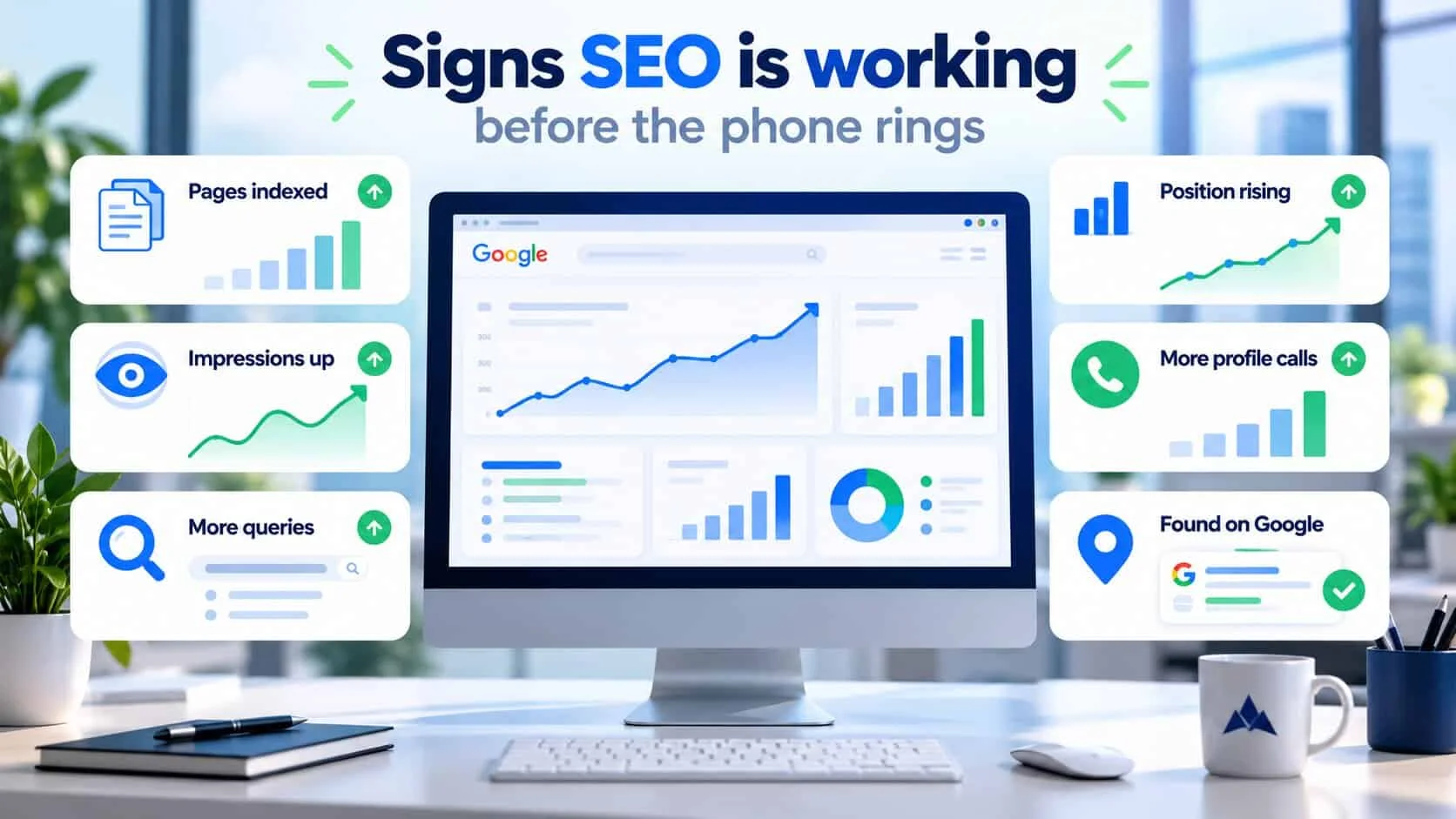
Your important pages are indexed
In Search Console’s Pages report, your homepage and service pages show as indexed.
Impressions rise month on month
Even with no clicks, more impressions mean Google is testing you for more searches.
You show up for more searches
The number of searches listed under Queries keeps growing.
Your average position moves up
From 60 to 40 to 20 is real progress, even before page one.
Your Google profile gets more calls
Calls and direction requests often rise before website enquiries do.
New customers say they found you on Google
Ask every new enquiry how they found you, and write it down.
The warnings
Red flags in SEO promises
Google itself says “no one can guarantee a #1 ranking on Google” (Google Search Central). Be careful with anyone who promises otherwise.
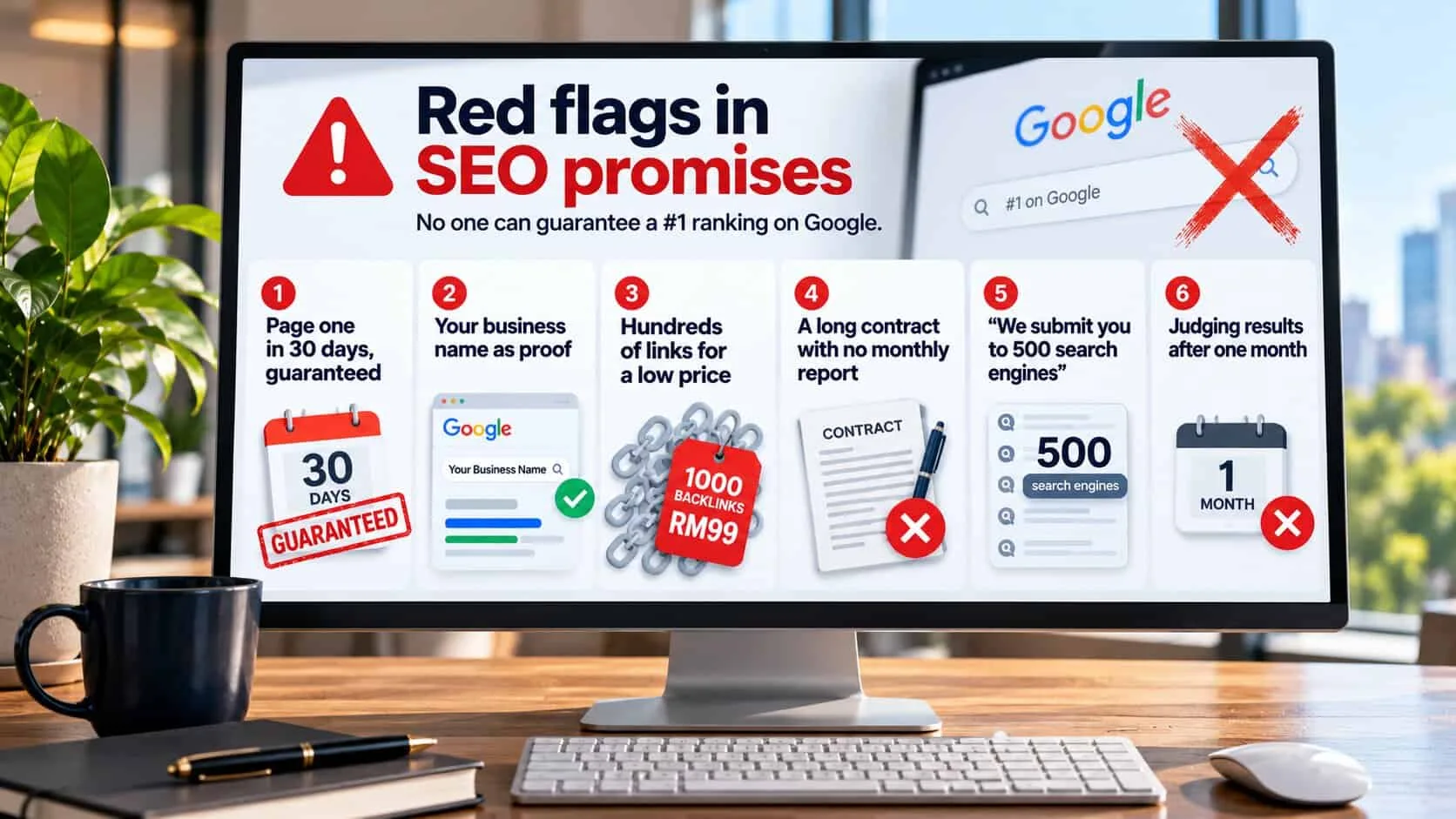
“Page one in 30 days, guaranteed”
No one controls Google. A promise like this is a guess, or a sign of risky shortcuts.
Your business name as proof
You should rank for your own name anyway. Ask for positions on service searches.
Hundreds of links for a low price
Bought links from unrelated sites can push you down. Real links come slowly.
A long contract with no monthly report
You should see impressions, positions and enquiries every month, in plain words.
“We submit you to 500 search engines”
In Malaysia, one search engine matters. Submitting to Google takes five minutes and is free.
Judging results after one month
One month is too early to judge anyone, including yourself. Judge at months 4–6, by the signs above.
Quick check: is your site ready for SEO to work?
5 questions · 30 secondsAnswer for your own website, honestly.
SEO timing: owners’ questions
How long does SEO take for a small business?
Usually three to six months before you see real movement in Google, and six to twelve months before it brings steady enquiries. Local, specific searches move faster; broad national searches take longer.
Can SEO work in one month?
For your business name, yes, once Google has indexed your site. For searches about your services, rarely. Anyone who promises page one in a month is guessing or using risky shortcuts.
Why do I get impressions but no clicks?
Your pages are showing far down the results, usually page three or lower. That is a normal early stage. Clicks tend to start once a page reaches the top 20.
Is Google Ads faster than SEO?
Yes. Ads put you at the top the day you pay, and stop the day you stop. SEO is slower but keeps working. Many small businesses run a small ads budget while SEO builds.
How long should I pay for SEO before judging it?
Four to six months. Then judge by the signs: more impressions, more searches, better positions and the first enquiries from Google. If none of these have moved by then, ask hard questions.
How much does monthly SEO cost in Malaysia?
Typically RM 1,000 to RM 5,000 a month (checked October 2026). For most local businesses, one-time website fixes plus free work on your Google Business Profile and reviews are worth doing before any monthly plan.
Keep reading
Getting found on Google
Indexing
Why is my website not showing up on Google?
A two-minute check, then nine reasons in the order to look.

SEO basics
SEO basics for owners who don’t want to learn SEO
What to do yourself, what to pay for, and the myths to ignore.
Local SEO
Local SEO: a Google Business Profile that ranks
Set up your profile properly, and the 12 checks that move you up.