
Why this goes wrong so often
Almost every owner I speak to has been through one disappointing website project. It rarely failed on skill. It failed because the brief was “make it look modern”, and nobody agreed what the site was supposed to do — so there was no way to tell whether it worked.
The good news: you can learn a lot in one meeting. You are not judging their style. You are checking if they think about your customers, or only about how the site looks.
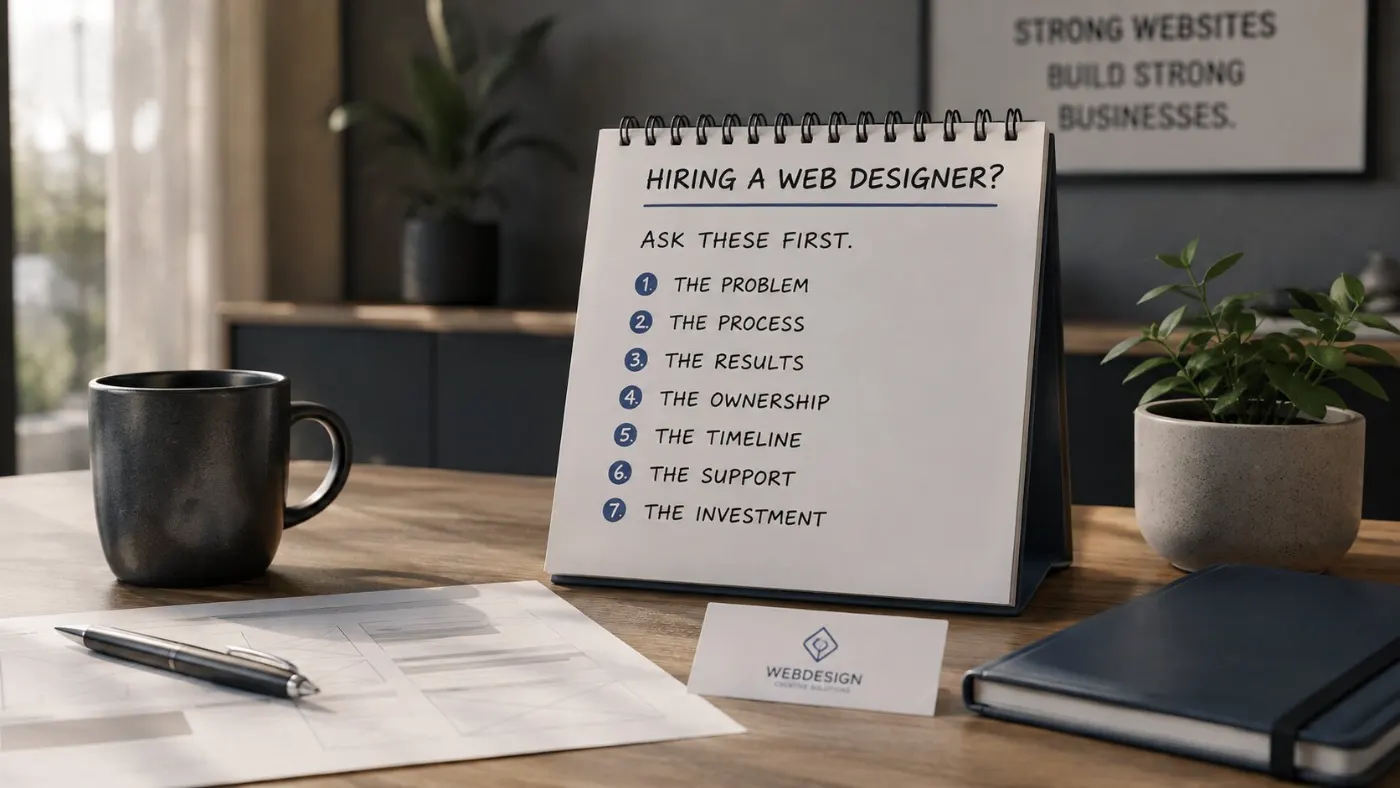
Seven questions to ask before you hire
Ask these in order. The answers to the first three tell you most of what you need to know.
“What problem was this site built to solve?”
Point at a site in their portfolio. You want to hear about business decisions — who the visitors were, what confused them, what changed. If you only hear about colours and fonts, they only decorate — they don’t plan for results.
“Who writes the words?”
This is the most costly misunderstanding in web design. If writing is not in the quote, it is not included — and your project may be stuck for three months waiting for you. Agree on it now, in writing.
“How will we know if it worked?”
A good answer names something you can count: enquiries a month, calls booked, quote requests. A weak answer is “you’ll love it”. You can’t improve what nobody measures.
“Who owns the site, the domain and the accounts?”
The answer must be you. Domain, hosting, analytics and the website files should all be in accounts in your name that you can open without asking anyone. This is the most common way small businesses get trapped.
“What happens the week after launch?”
Launch is the start, not the end. Ask who fixes things that break, how updates are done, and if you can edit your own text. Get the answer before you pay.
“How many revision rounds are included?”
“Unlimited changes” sounds generous, but usually means a tiring project nobody wants to finish. Two planned rounds with clear feedback is better than endless small changes, for both sides.
“Can I speak to a client from two years ago?”
Recent clients are still happy and excited. A client from two years ago can tell you what happened later — and if the designer still answered calls a year after launch.
Red flags worth walking away from
None of these are about price. All of them predict pain.
What a fair quote includes
Two quotes for “a website” can differ by four times and both be honest, because they are not quoting the same work. Before comparing prices, make sure both quotes include these seven things.
For real numbers, see website redesign cost for a small business — including what pushes a quote from $1,500 to $6,000, and how to tell whether you need a rebuild at all.
Quick check: are you ready to talk to a web designer?
5 questions · 30 secondsOpen your website on your phone, then answer honestly.
Freelancer, agency, or platform?
A DIY platform
Cheapest, and fine for a simple website. The cost is your time, and there is a limit to what you can do: the hard part is not building, it is deciding what to say.
A specialist freelancer or small studio
The best choice for most small businesses. You speak to the person doing the work, decisions are fast, and you pay for the work, not office costs. Check they have experience with businesses like yours.
An agency
Good when you need several experts at once and have the budget. Ask who will actually do the work — the person who meets you is often not the one doing your project.
Common questions
Should I hire a freelancer or an agency?
For most small businesses, an experienced freelancer or very small studio is the better choice — you talk to the person doing the work. Agencies make sense when you need several types of experts at once and have the budget.
How do I know if a web designer is any good?
Ask what problem each portfolio site was built to solve, and what happened after. A good designer talks about decisions and results. A weaker one only talks about how it looks.
Who should write the website copy?
Someone has to, and it changes the price the most. If writing is not in the quote, assume it is not included — and that you will be asked to write it later.
What should be in the contract?
Number of pages, who writes the text, rounds of changes, who owns the files and accounts, what happens after launch, and when to pay. Anything unclear becomes an argument later.
What clients say about working with me
A highly reliable WordPress and technical SEO specialist.
He delivers fast, high quality work with strong attention to detail. What sets him apart is combining creative thinking with SEO driven structure for long term visibility.
 Stephen Chong
Branding & Marketing Strategist
Fast turnaround and clear communication throughout.
Richard played a key role in our book launch. He turned our ideas into a clear, conversion focused website, and the site truly supported our goals.
 Lorna Nirmala Devi
Founder, Melaka Chetti Kitchen