

Nobody buys a website. They buy a result they hope a website will produce.
This is where most small business website projects go wrong. The owner wants more enquiries. The quote talks about pages, plugins and systems. Both sides sign and are happy — and a year later the site is live, but the phone rings just as often as before.
I have been the web designer in these conversations since 2007, on 256 projects. The pattern is clear: projects work when the owner knows what they are buying before they start. Not the technology — the result they want, the budget for it, and how they will know it worked.
This series covers the whole buying decision, in the order it happens. Start wherever you are.
Most people skip straight to three
The four decisions, in order
-
1
Decision 1 · Goal
What is the site for?
One sentence, one result you can measure. “Enquiries from homeowners within 40km” is a clear goal. “A modern online presence” is only a wish — nobody can deliver it or check it. If you can’t write the sentence, nobody knows when the project is finished.
-
2
Decision 2 · Scope
Fix, rebuild, or start over?
A site with a good layout but bad text is a two-week fix. A site built on a page builder that is no longer updated needs a rebuild, like it or not. Getting this wrong is costly either way: paying for a rebuild you didn’t need, or paying twice because a quick fix didn’t last. The four questions that settle it →
-
3
Decision 3 · Budget
What should it cost?
Prices vary a lot, which is confusing: from a few hundred ringgit to five figures, for things all called “a website”. The price depends on how much work it is, who writes the text, and whether anyone is responsible for results. My website redesign cost guide shows real prices, in USD and RM.
-
4
Decision 4 · Builder
Who builds it?
This is the last decision, not the first. Once you know the result you want, the work needed and the budget, choosing a designer becomes a simple comparison — not just a feeling about who seemed nicest on the call.
What good looks like
Owners rarely see a well-run website project before they buy one, so they don’t know what to expect. Use this on your next call: what good looks like at each stage, the warning sign to listen for, and one question to ask.
-
Stage 1 · First call
The conversation is about your business, not the website
Good
They ask who your best customers are, how they find you, what they ask before buying, and what an enquiry is worth.
Warning sign
The first call is only about number of pages, colours and which template you like.
Ask your designer“What will you ask me before you start designing?”
-
Stage 2 · Quote
One measurable outcome is written into the quote
Good
“Twelve enquiries a month from homeowners within 40km.” Both sides can check it.
Warning sign
The goal is “a professional online presence”. Nobody can achieve it, miss it or check it.
Ask your designer“What result will this site be measured on?”
-
Stage 3 · Content
Copy comes before layout
Good
The words are agreed first, and the design is built around them.
Warning sign
You are asked for your content only after the design is approved, so headlines just fill a space.
Ask your designer“When do we write the words, and who writes them?”
-
Stage 4 · Design
Every page has one obvious next step
Good
Call, enquire, book or buy. One action, repeated and easy to see.
Warning sign
Five equal buttons on the homepage. Visitors pick none of them.
Ask your designer“Which one action is each page built to get?” Ask it when you are shown the design.
-
Stage 5 · Launch
Launch is a milestone, not the finish line
Good
A proper handover: how to edit it, what to check, and who helps in month three.
Warning sign
The designer disappears after launch, and the site quietly stops working within 18 months.
Ask your designer“What happens after launch, and what does it cost?”
Already have a quote in hand? Check it against the web design quote red flags →
What the money buys at each band
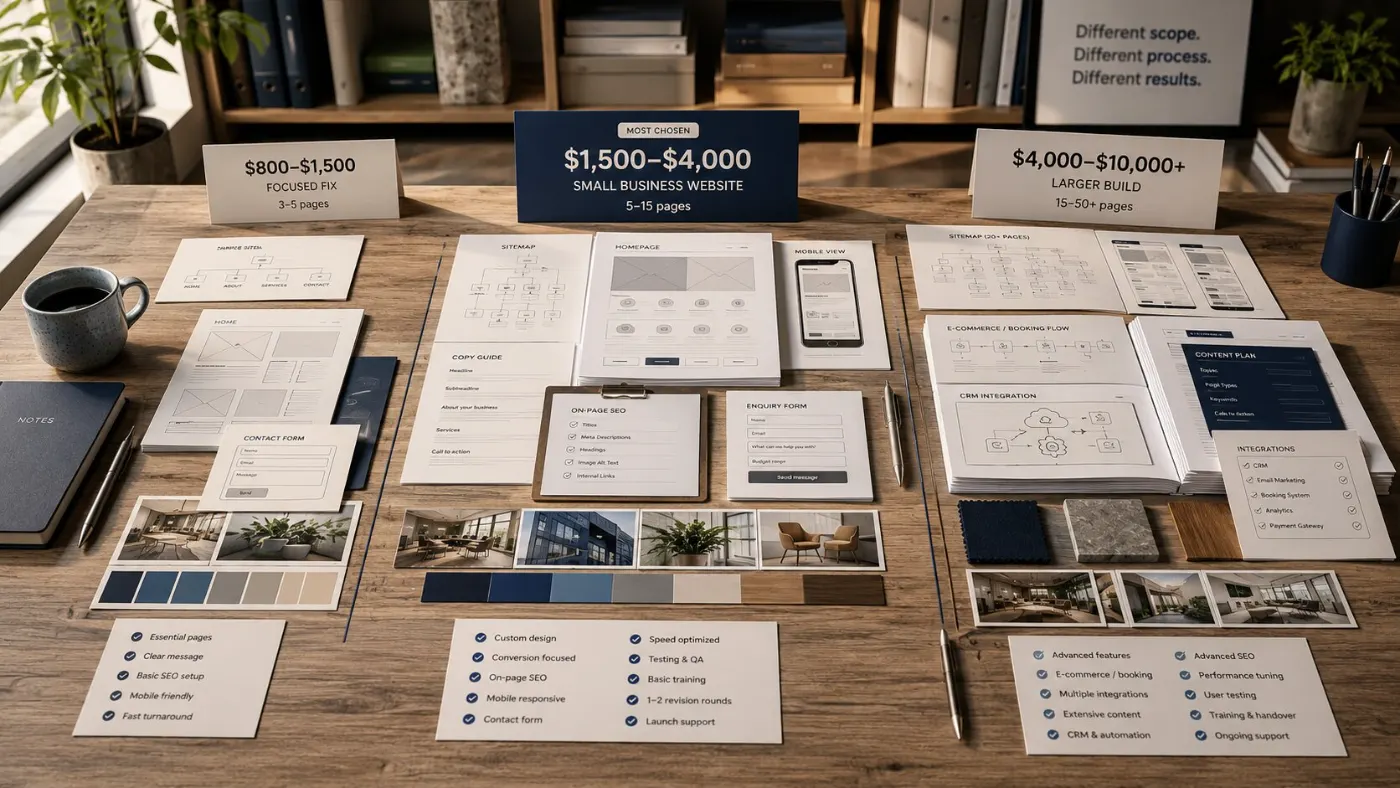
Three price ranges cover almost every small business project. The difference is how much work is done, not the quality — a small fix should be built as well as a full site.
Focused fix
USD 800 – 1,500
About two weeks
Scope1–3 pages
Usually the homepage, your main service page and the contact step, rewritten and rebuilt.
Best whenThe site works but gets few enquiries.
Most chosen
Full small business site
USD 1,500 – 4,000
Three to six weeks
Scope5–10 pages
Every page written and planned around how your customers decide.
Best whenStarting fresh, or the old site can’t be saved. Eight in ten projects are here.
Larger build
USD 4,000 – 10,000+
Six weeks or more
Scope10+ pages
Online shop, bookings or connections to other systems. Planned properly before anyone gives a price.
Best whenYou sell, book or connect systems online.
Two things are not included in these prices and need a separate budget: photography, and connecting to software you already use. Full website redesign cost breakdown, including Malaysian ringgit ranges →
Template, freelancer or agency?
Once you know what you need, there are three ways to get it built. None is wrong. Each suits a different owner. Problems start when someone pays agency prices for a template, or expects agency-level service from a do-it-yourself builder.
| DIY template | Right for mostFreelancer | Agency | |
|---|---|---|---|
| Right for | Testing an idea, or a business that doesn’t rely on web enquiries | Most small businesses, if you check references and ownership terms | Larger builds, integrations, or several people to keep happy |
| Who writes the copy | You | Varies. Ask before you sign | Usually a copywriter, billed separately |
| Who is accountable | Nobody but you | One person, which cuts both ways | An account manager, not always the builder |
| Biggest risk | A tidy site that says nothing specific | They disappear after launch | Paying for process a five-page site doesn’t need |
Whichever you choose, ask the same thing: can they tell you, in one sentence, what the site should achieve for your business? Seven questions to ask before you hire →
Three ways the money leaks
Paying too much rarely looks like a high price. It looks like a fair price for the wrong thing.
Buying pages instead of outcomes
Ten pages cost more than five and often get fewer enquiries, because visitors have ten ways to get lost. Decide the number of pages by how customers get to an enquiry, not by a page count that looks like good value.
Paying twice because the patch did not hold
A cheap fix on a site built with an old, unsupported page builder only lasts months, not years. If you will need a rebuild within two years anyway, the honest cheap option is a small rebuild — three good pages are better than ten patched ones.
Buying a system nobody will maintain
A powerful platform you can’t update yourself becomes an old website with a yearly bill. Choose tools for the person who will actually use them — usually you, now and then, between other work. What upkeep really involves →
Live now
Read these

Start here
Why your website isn’t converting — and what to fix first
The seven most common reasons, starting with the one that costs you the most. Read this before you spend anything.
10 min read

Checklist
Small business website checklist: 14 things every site needs
Fourteen simple checks for your website, with the three most important ones marked.
7 min read

Hiring
How to choose a web designer for your small business
Seven questions to ask before you hire, six warning signs, and what a fair quote should include.
8 min read

Malaysia pricing
How much does a website design cost in Malaysia?
RM prices for each type of website, the yearly costs after launch, and how to spot a quote that is too cheap.
8 min read
Pricing
Website redesign cost: what a small business really pays
Three honest price ranges, what makes a quote go up, and what should always be included.
9 min read

Hiring
10 red flags in a web design quote
Warning signs in a quote that cost you money later, and what a fair quote should include.
6 min read

Platform
WordPress vs static website: which suits a small business?
Cost, speed, safety and ease of editing compared side by side, with a simple test to help you choose.
8 min read

Fix or rebuild
Redesign or rebuild? How to tell which your website needs
Four simple questions to help you decide, with RM costs and how to keep your Google ranking.
7 min read

Checklist
What to prepare before hiring a web designer
The answers, photos, logins and budget to get ready first, so the job goes faster and costs less.
8 min read
Timelines
How long does it take to build a website?
Real timelines by type of site, week by week, and what makes projects run late.
8 min read
Proof
Then look at these

Questions owners ask before they buy
How much should a small business website cost?
Most cost between USD 1,500 and 4,000 for five to ten pages planned around how customers decide. A small fix to two or three pages costs USD 800 to 1,500. Anything with an online shop, bookings or connections to other systems starts at about USD 4,000. The price depends on the amount of work, who writes the text, and whether anyone is responsible for results.
How long does it take?
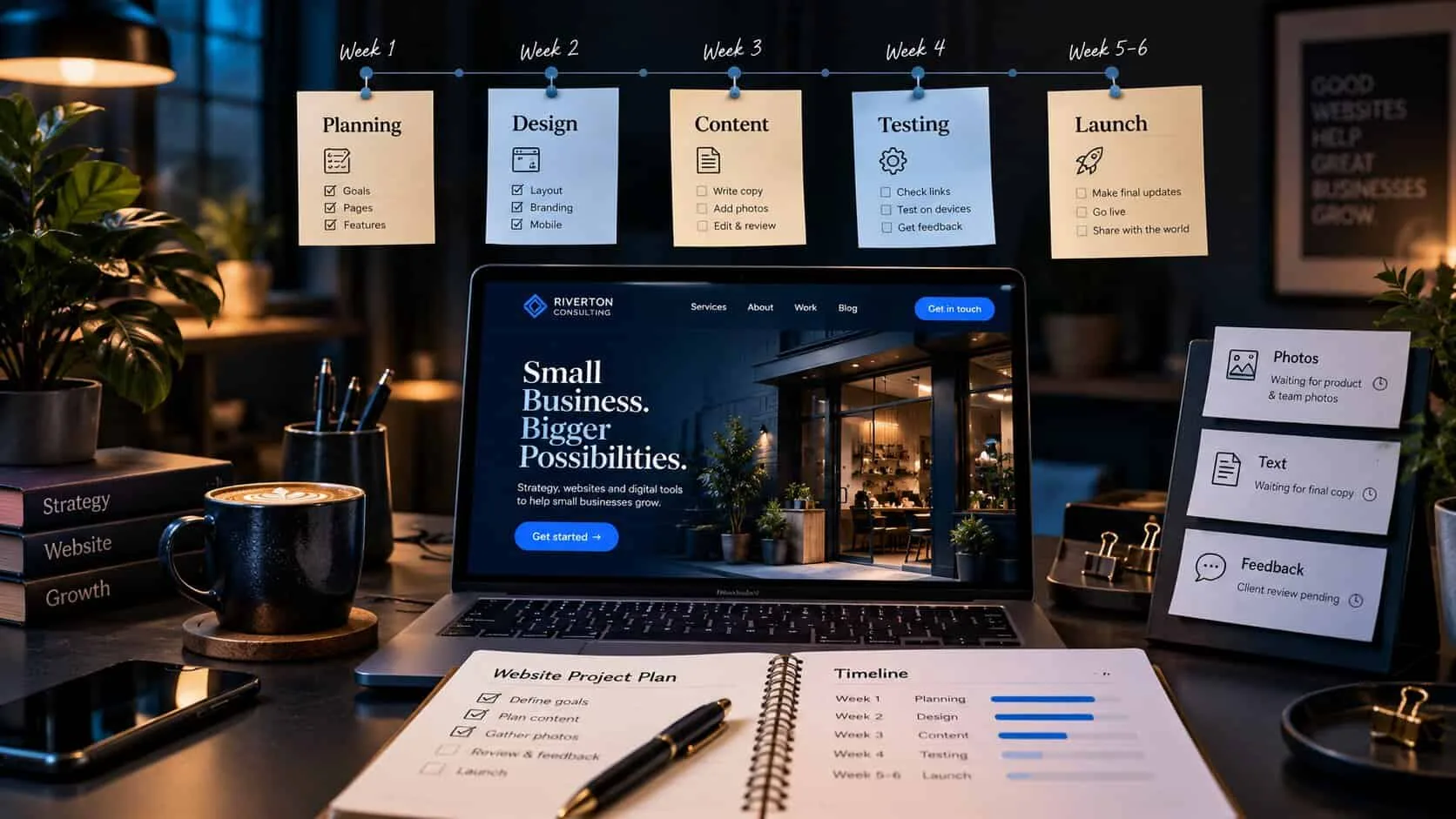
Two weeks for a small fix, three to six weeks for a full site, six weeks or more for bigger builds. Delays come from content, not building — the fastest projects are the ones where photos, service details and prices were ready before work started. See the week-by-week timeline.
Should I fix my existing site or rebuild?
Fix it if the site is in good shape and the problem is the message. Rebuild if it uses an old, unsupported page builder, breaks when you edit it, doesn’t work well on phones, or takes more than four seconds to load on a phone. A quick fix on a broken base means paying twice.
Do I have to write the content myself?
You provide the basic information — what you do, for whom, what it costs, why people choose you, and proof. Turning that into words that get enquiries is the designer’s job, and should be in the quote. “Client to supply all content” means you are only buying a template.
What should a quote include?
The pages, who writes the text, rounds of changes, phone testing, speed targets, who owns the domain and hosting, what happens after launch, and the cost of a change in month three. A quote with only a page count and a price is hiding where the work is. The full hiring checklist →
How will I know it worked?
Decide how to measure success before you build — enquiries, calls, bookings, quote requests — then track it. A site that looks better but gets the same number of enquiries has not worked, no matter how happy everyone is at launch.
Before you ask for quotes
What should a site like yours cost?
Three questions about your project. You get the usual price range and timeline — so no quote will surprise you.