
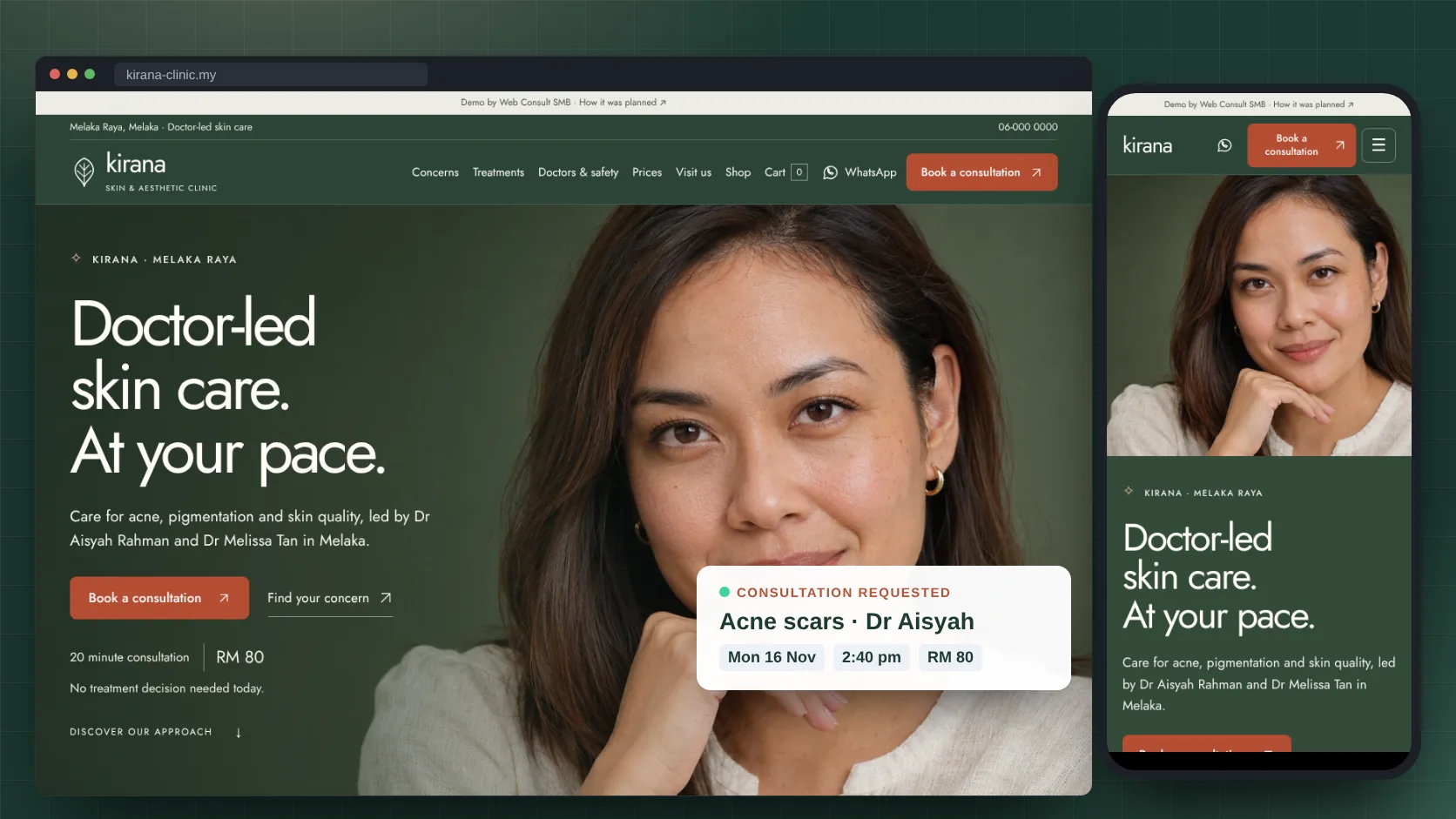
The short answer
Someone thinking about a skin treatment has three worries. Calm them, and they book.
Every section below exists to answer one of these. In Malaysia a clinic also has to do it within strict advertising rules, so the usual tricks, before and after photos, reviews and promotions, are off the table. That turns out to be fine.
Who will actually treat me?
A named doctor, with registration numbers anyone can check, in a licensed clinic.
What will it really be like?
Sessions, downtime, side effects and cost, said plainly, including who should wait.
Will I be pushed to buy?
A fixed consultation fee, a written plan and no decision needed on the day.
The example is a doctor led skin and aesthetic clinic. If you run a beauty salon or spa without doctors, most of the layout still works, but you can’t offer injections or other medical treatments. Kirana Skin & Aesthetic Clinic is a made up clinic; its doctors, photos, prices and numbers are illustrative placeholders.
Page 1 · The homepage
The full homepage, section by section
Read it top to bottom, the way someone would before deciding to book. Each numbered pin matches the note beside it.
The whole page at a glance
Fifteen sections, in the order a nervous first timer reads
Who leads the care comes first, then the four worries, the clinic, the concerns and the doctors. Honest detail follows: what to expect, doctor answers, the first visit, treatments, safety and the fee. A small shop, skin guides and one easy ask close the page. Tap any section to jump to its note.
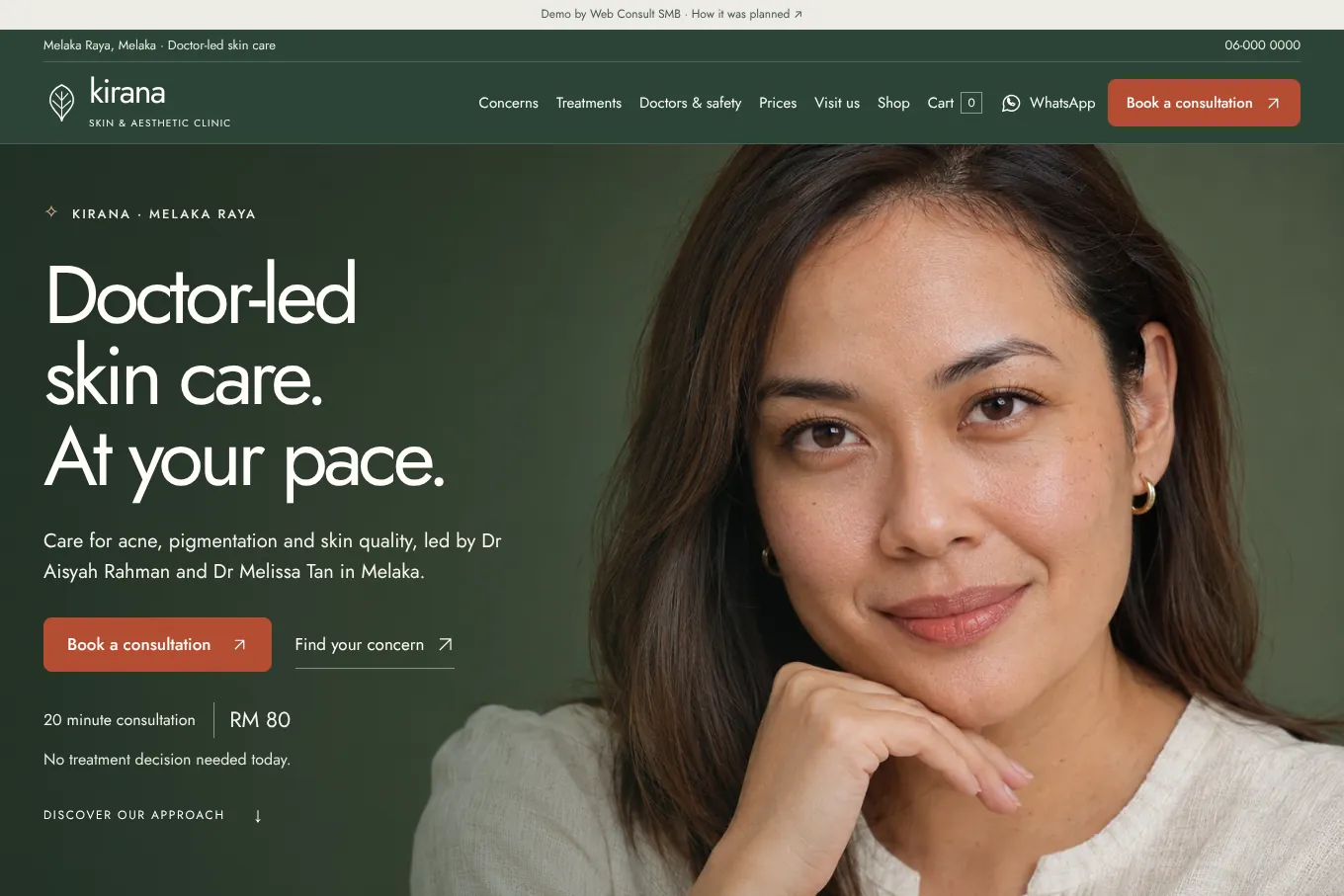
Header
Keep “Book a consultation” and WhatsApp in the header
The menu follows how people think about their skin: Concerns, Treatments, Doctors & safety, Prices, Visit us. The address line sits above it. The terracotta booking button stays on screen as they scroll, and WhatsApp sits right beside it for the shy ones.
Hero
Say who leads the care, in the first screen
“Doctor led skin care. At your pace.” The line under it names both doctors and the town. Under the buttons: “20 minute consultation · RM 80 · No treatment decision needed today.” That one line answers the biggest fear before anyone has to ask.
Clinic tipPut the consultation fee in the hero. People who worry about being pushed into a package relax when they see a fixed, small first step.
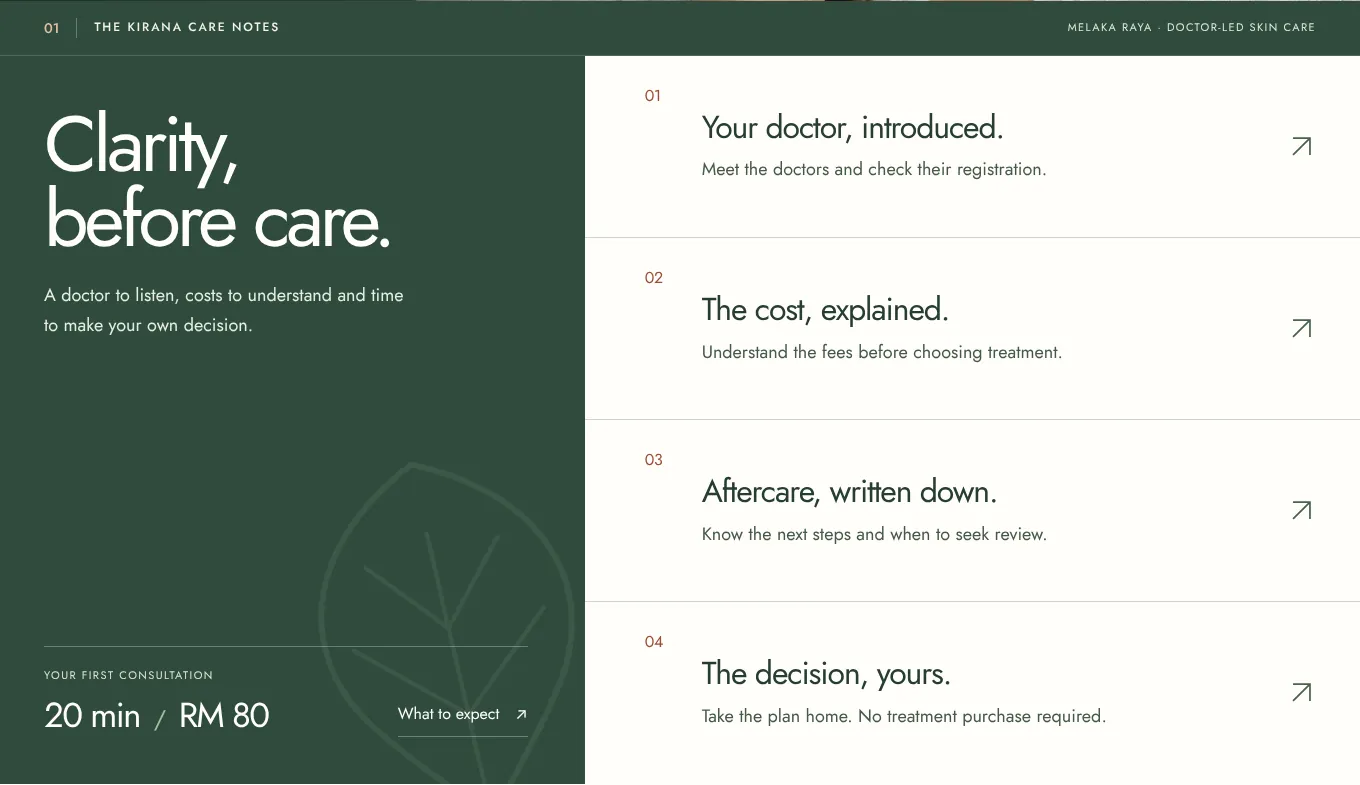
Four worries
Answer the four worries before they ask
Your doctor, introduced. The cost, explained. Aftercare, written down. The decision, yours. Four short lines, each linking to the page with the detail. This is the clinic’s promise, and it replaces the usual “why choose us” badges.
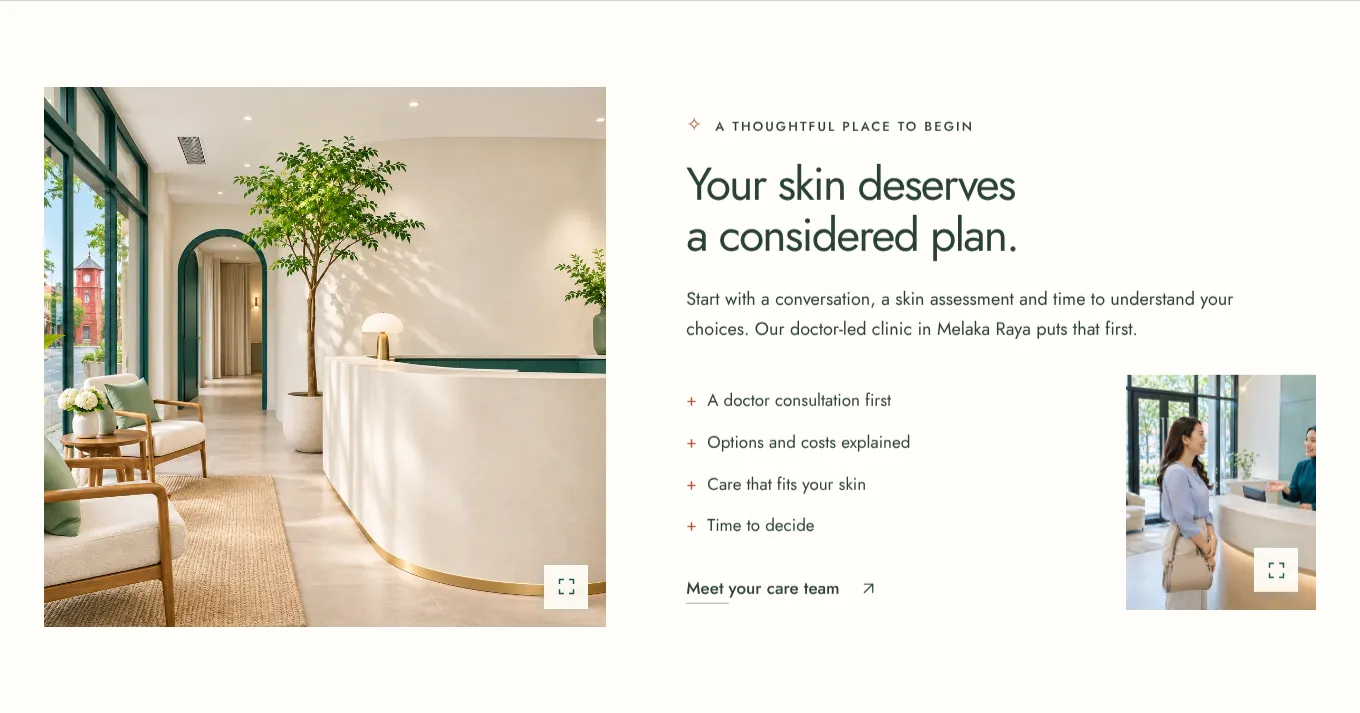
The clinic
Show the clinic as it really is
Reception, the consultation room, the people who work there. A first timer wants to picture walking in. Then three ticks: a doctor consultation first, options and costs explained, time to decide.
Clinic tipUse photos of your own clinic and team. If a treatment photo uses a model, label it “for illustrative purposes only”, as the advertising board asks.
Concerns
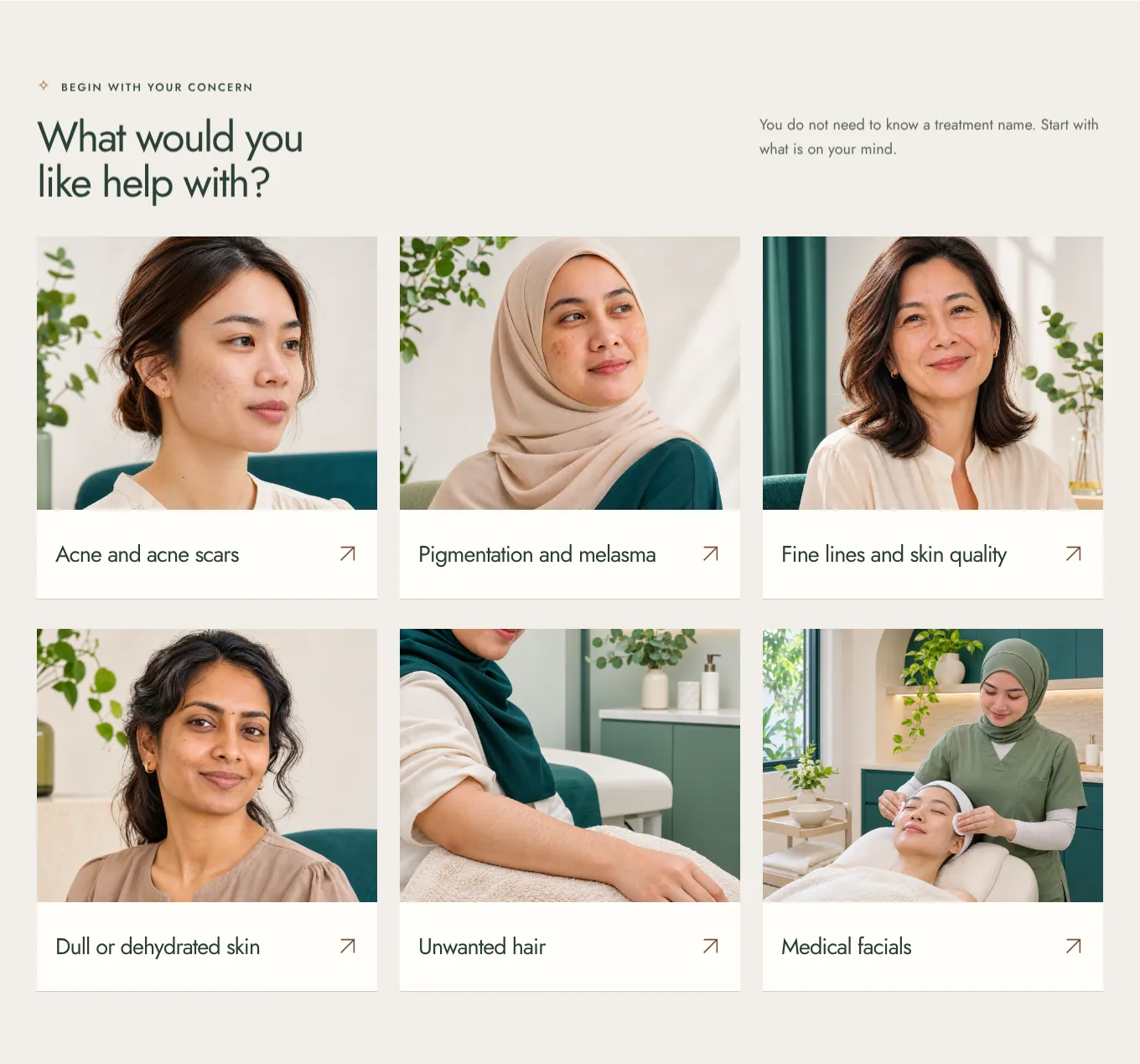
Start from the concern, not the machine name
People search “acne scars” or “melasma”, not “fractional CO2”. Six photo tiles with plain names let each visitor tap their own worry and land on a page about it.
Doctors
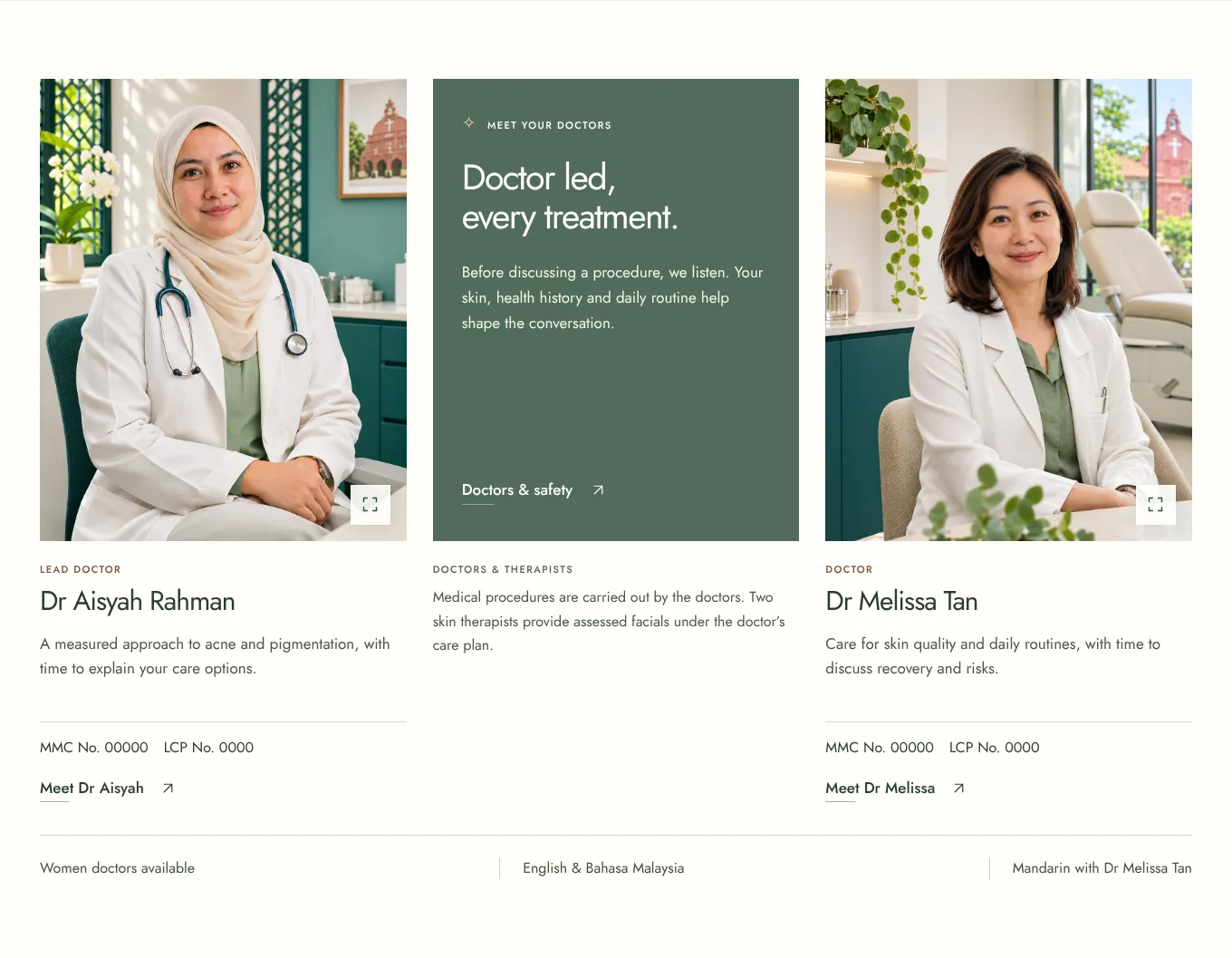
Introduce the doctors by name, with numbers anyone can check
A photo, a short bio, the MMC and LCP numbers, the languages spoken and “women doctors available”. In a field where people worry about who is really holding the needle, this section does more than any slogan.
Clinic tipLink each doctor’s name to the Medical Council’s online register, so anyone can check it themselves.
What to expect
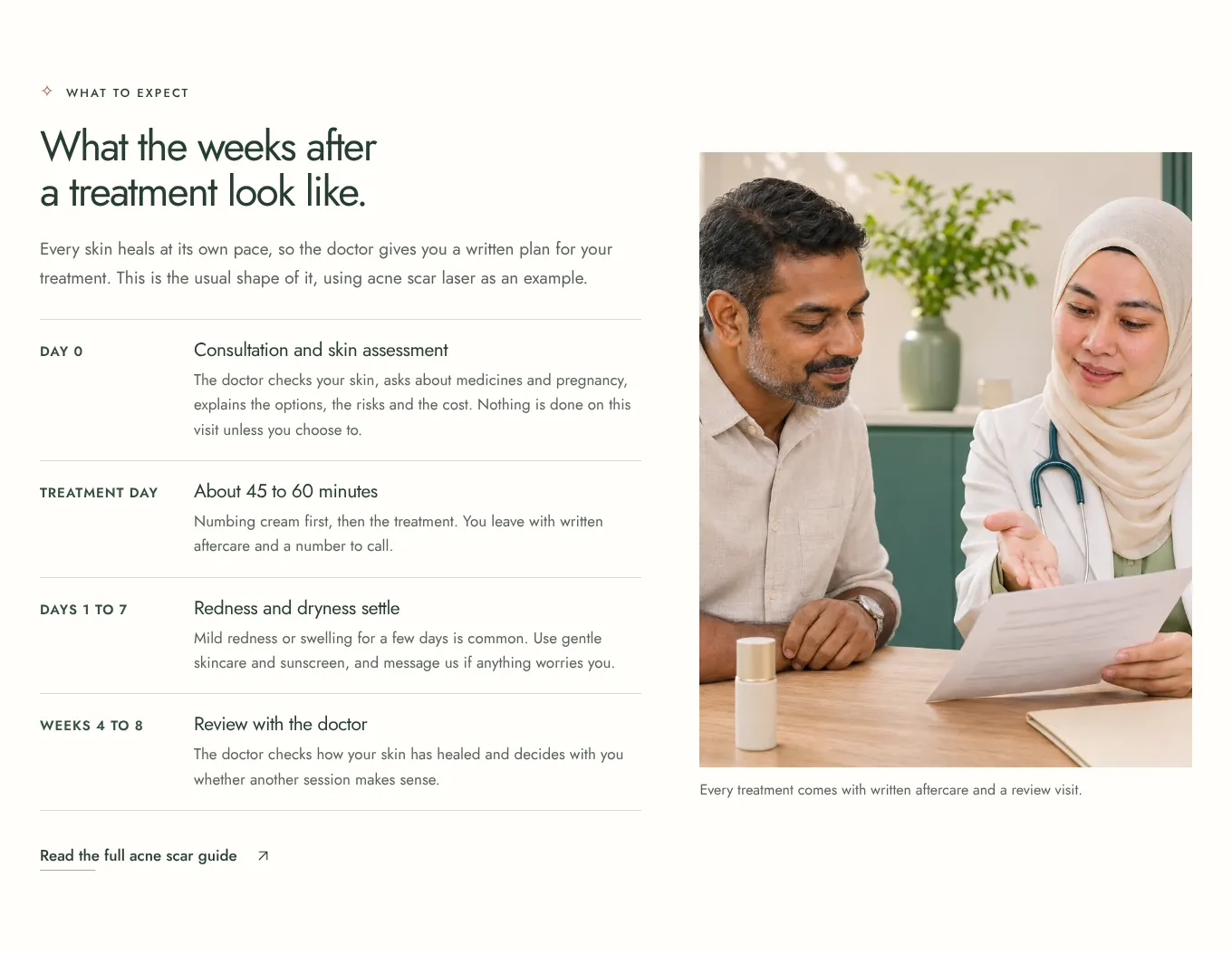
Show the weeks after a treatment, honestly
Clinics in Malaysia can’t show before and after photos. A plain timeline does the job better anyway: what happens at the consultation, on the day, in the first week and at the review. It shows what recovery feels like, with no promise about results.
Clinic tipThis section replaced a before and after slider in the first version of the demo. See the advertising rules for why.
Doctor answers
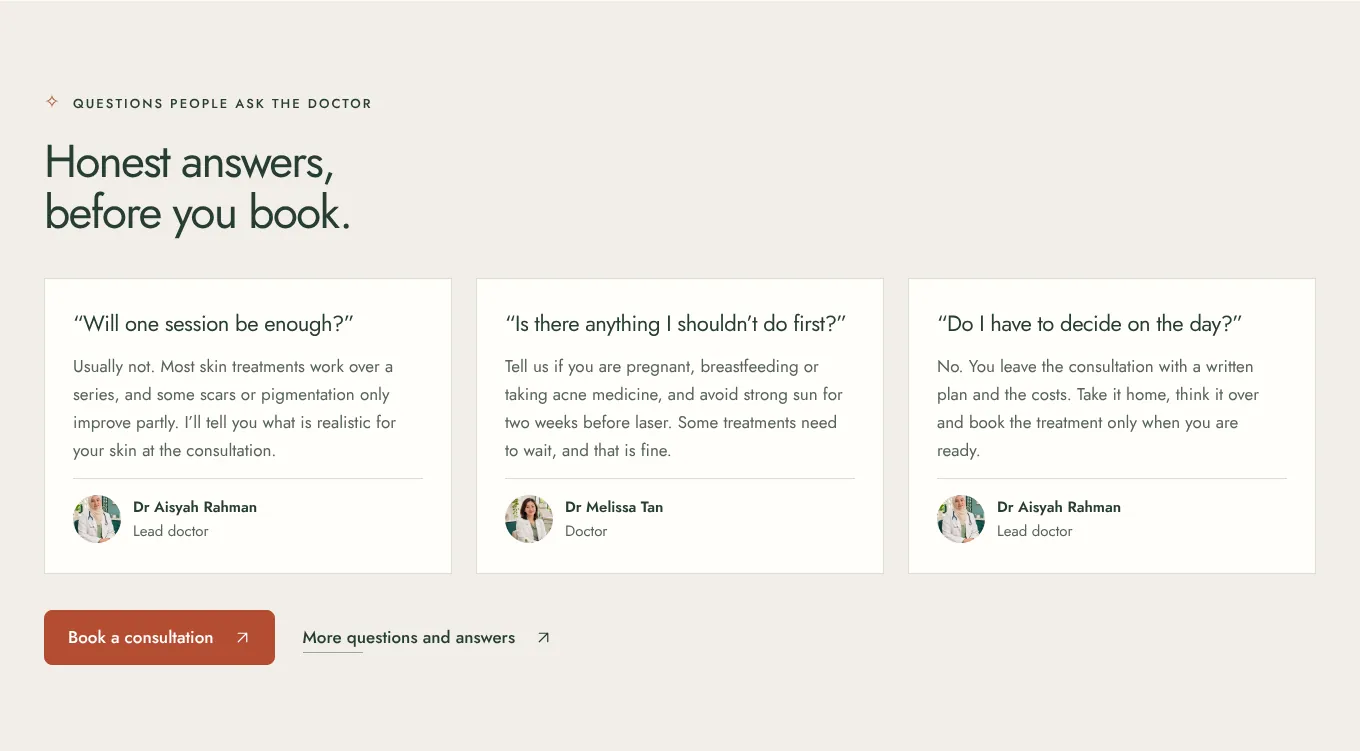
Let the doctors answer the real questions, in their own words
“Will one session be enough?” “Usually not.” Three honest answers, each signed by a doctor. It gives the warmth people look for in reviews, without using patient testimonials, which a clinic shouldn’t put on its website.
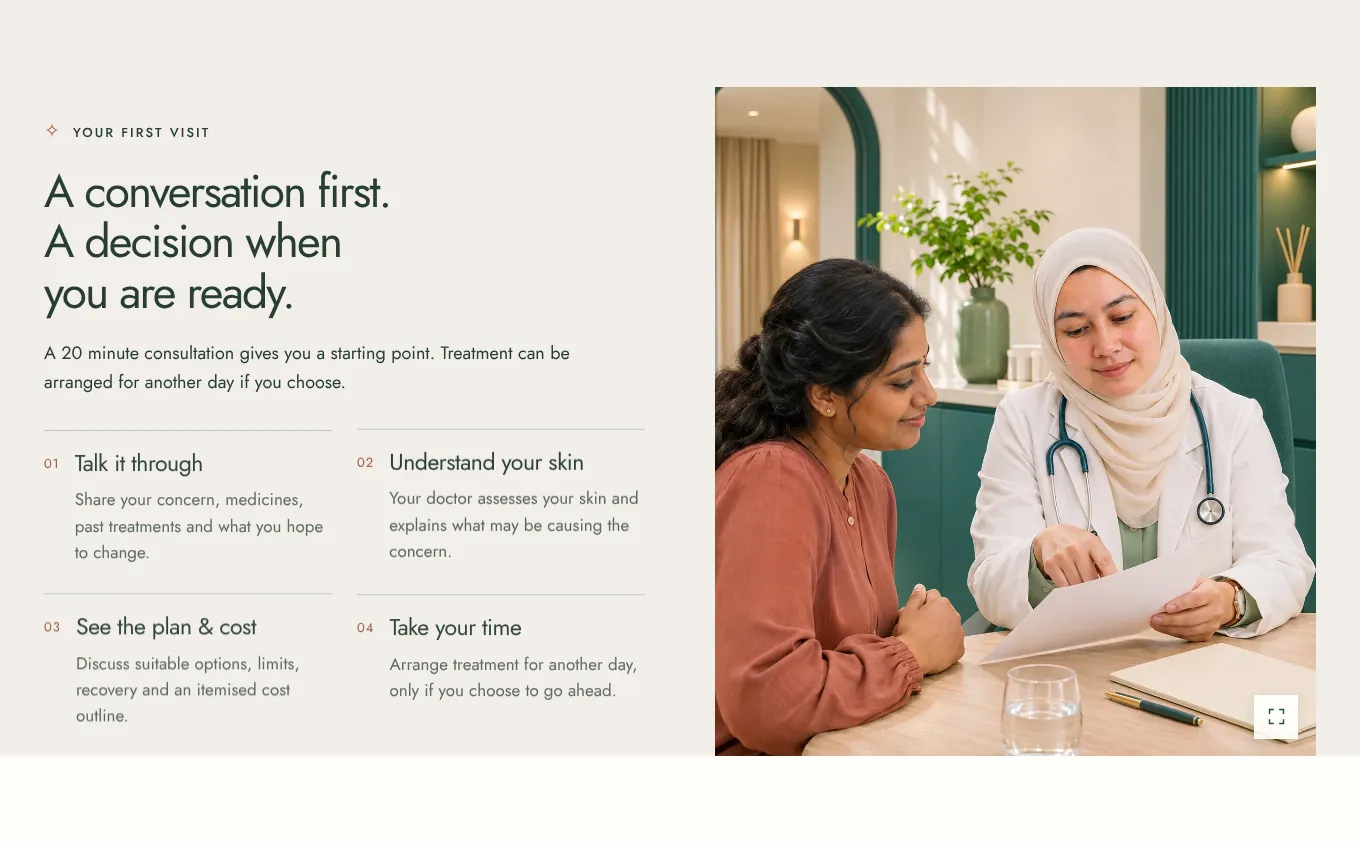
First visit
Make the first visit feel low pressure
Talk it through, understand your skin, see the plan and cost, take your time. Treatment can be arranged for another day. Saying this out loud is what gets a nervous person to book the first step.
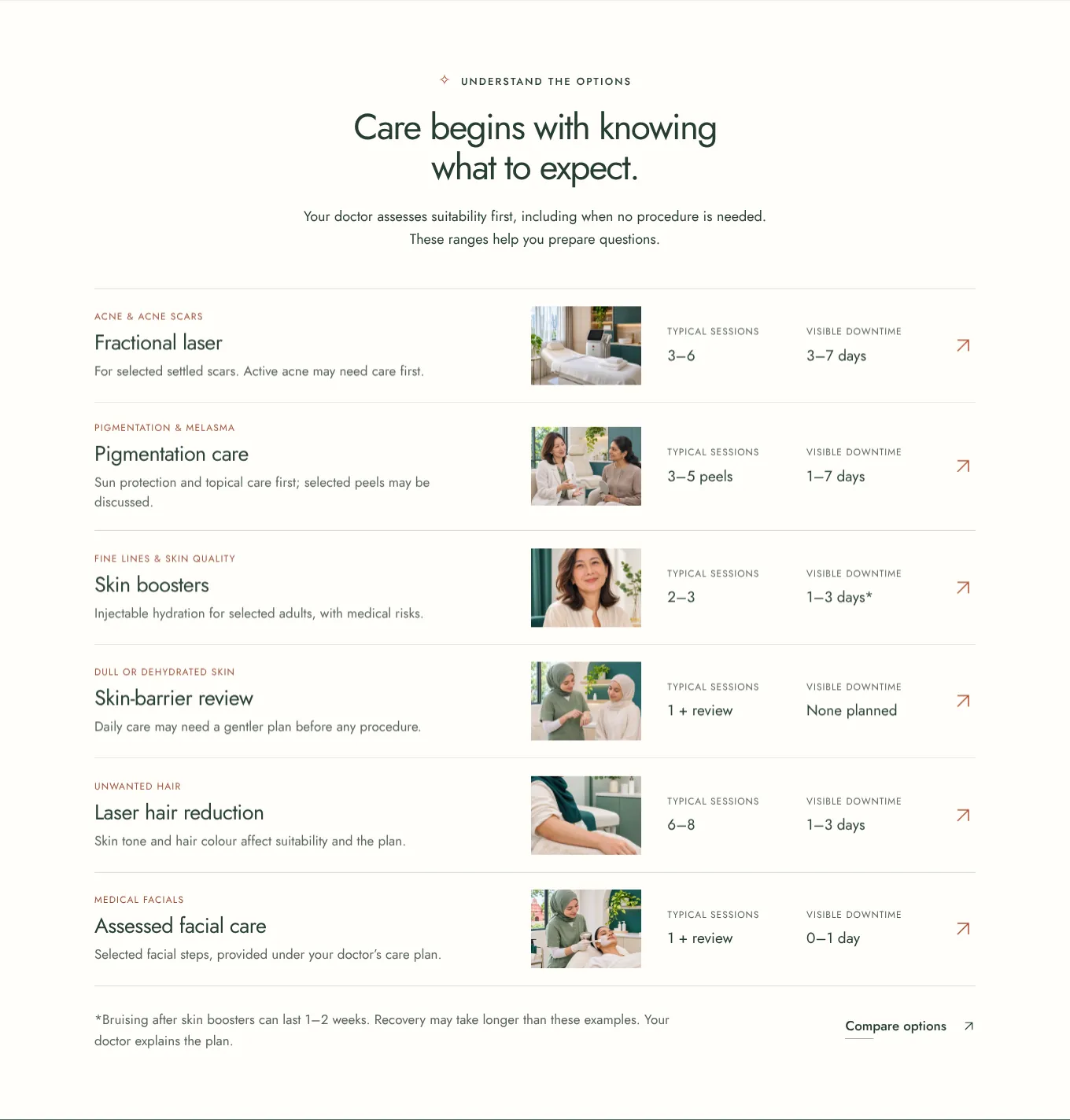
Treatments
Put sessions and downtime on every treatment row
Fractional laser: 3 to 6 sessions, 3 to 7 days of visible downtime. Skin boosters: 2 to 3 sessions, 1 to 3 days. Someone planning around a wedding or a work trip finds their answer without reading a whole page.
Clinic tipWrite “typical” and “usually”, and say the doctor confirms it. Exact promises about recovery or results are exactly what the rules warn against.
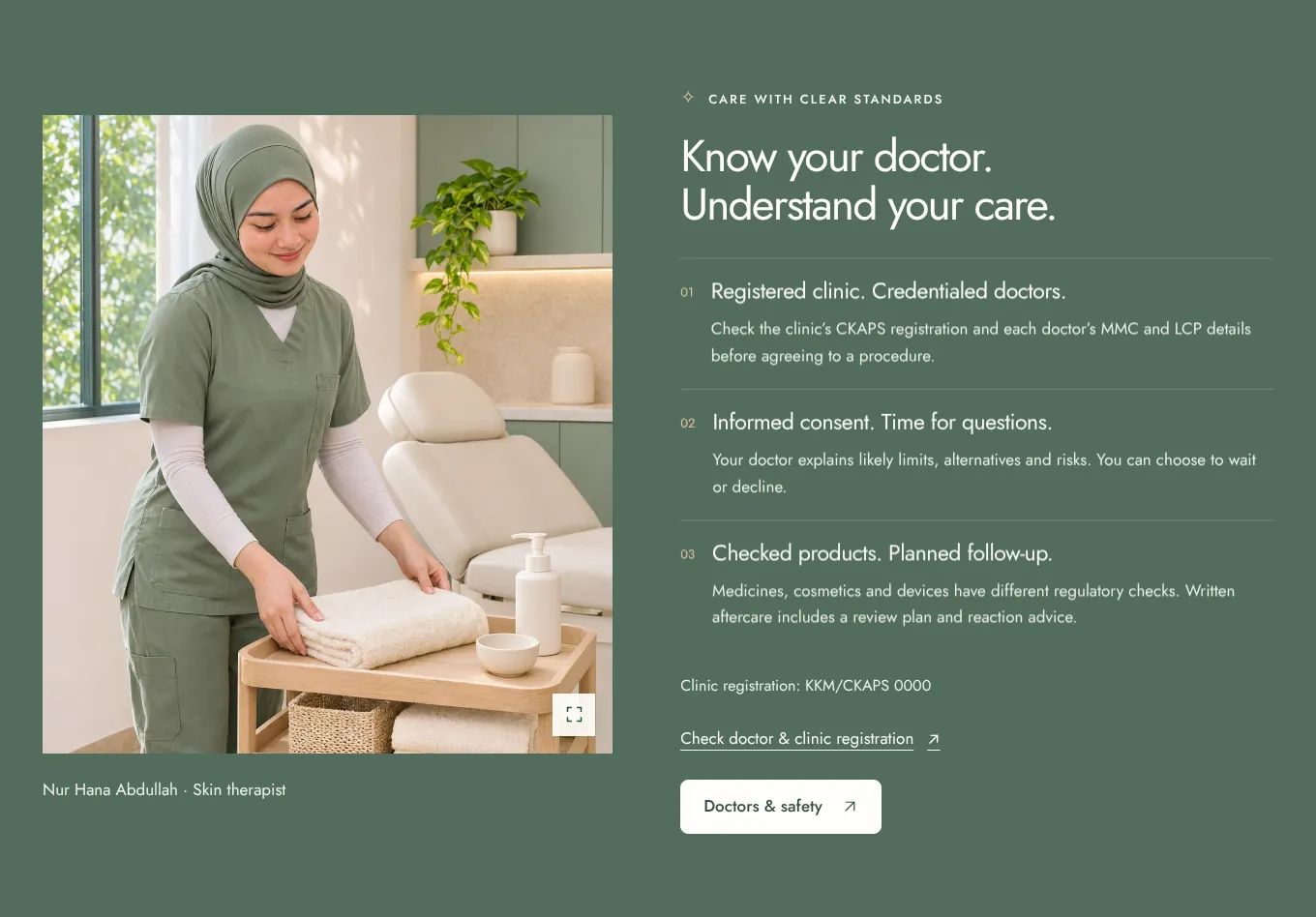
Safety
Make safety a section, not small print
Registered clinic, credentialed doctors. Informed consent, with time for questions. Checked products, planned follow up. People have read the news about unlicensed beauty “clinics”. This section tells them how this one is different, and how to check.
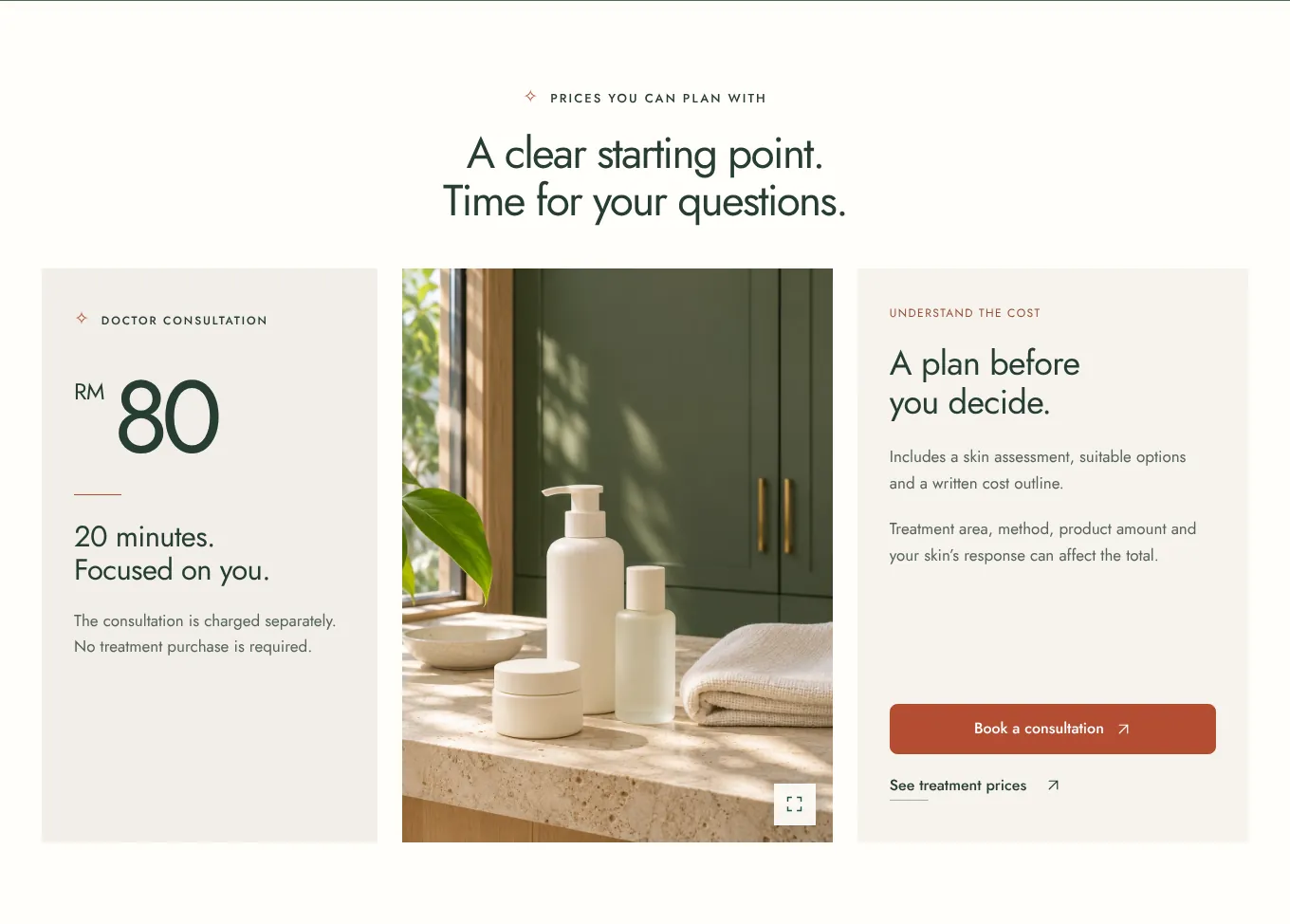
The fee
Put a real number on the consultation
RM 80 for 20 minutes with a doctor, charged separately, with no treatment needed. Treatment prices sit on their own page, and the plan and cost come in writing after the assessment. One clear number feels safer than “price on request”. See should you show prices.
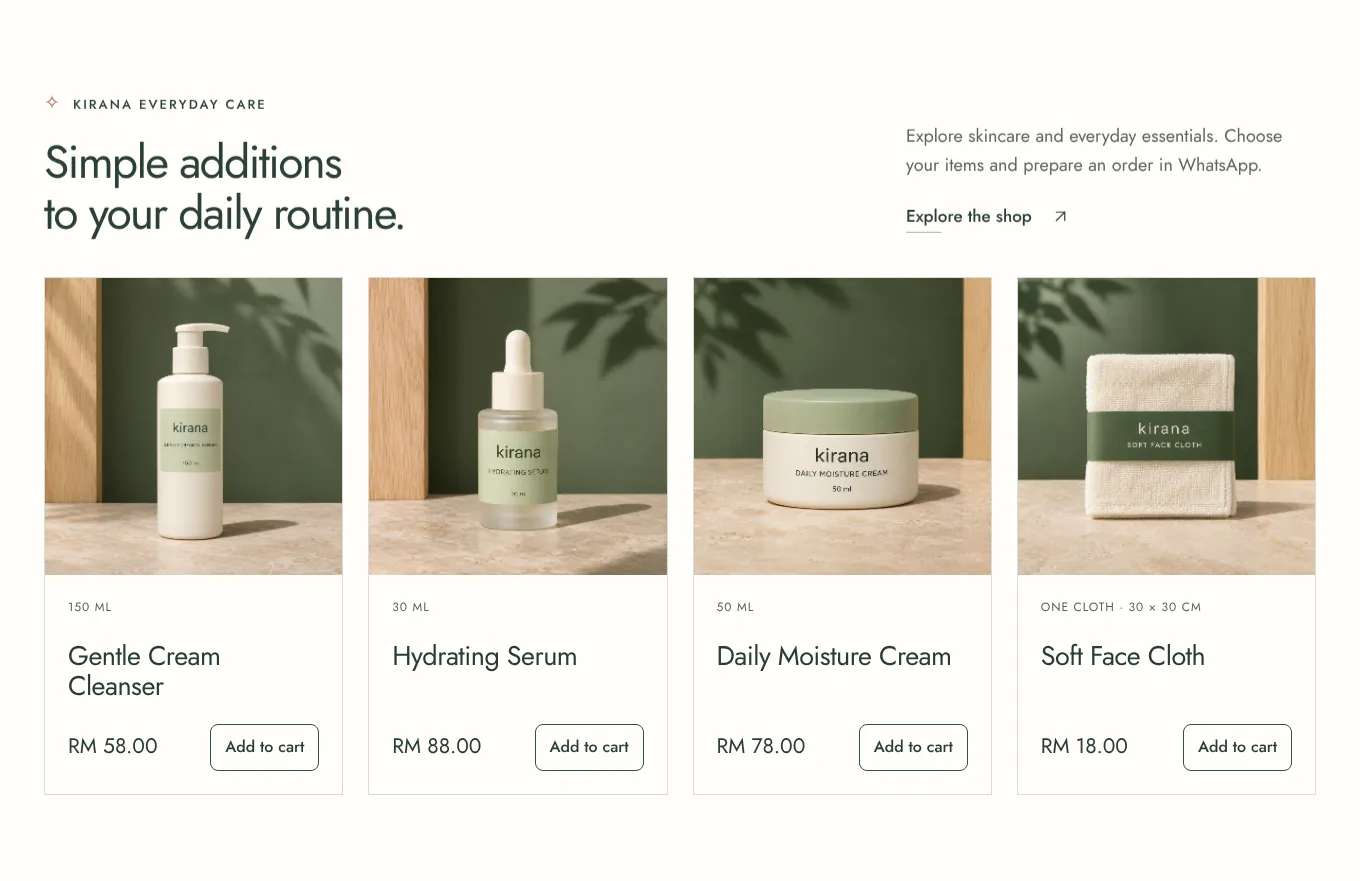
Shop
Keep the shop small, and below the care
Four everyday products, a cleanser, a serum, a cream and a face cloth, with prices. The shop sits after the doctors, the safety and the fee, so the page still reads as a clinic first. More on the shop pages below.
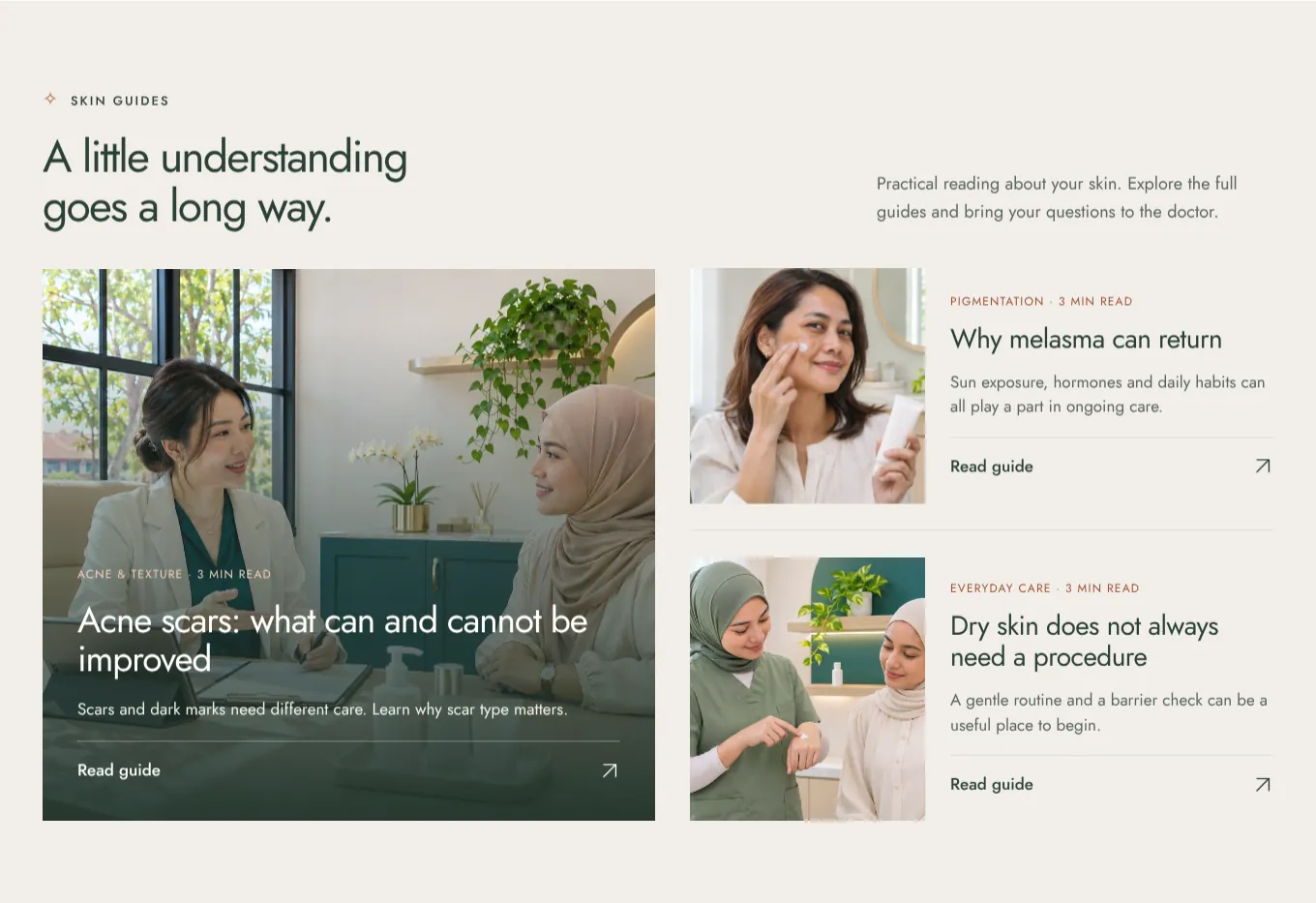
Skin guides
Teach first. The bookings follow.
“Acne scars: what can and cannot be improved.” “Dry skin does not always need a procedure.” Honest guides, with sources, show the doctors know their field. The Medical Council expects clinic information to be educational, and these are what people share with a friend.
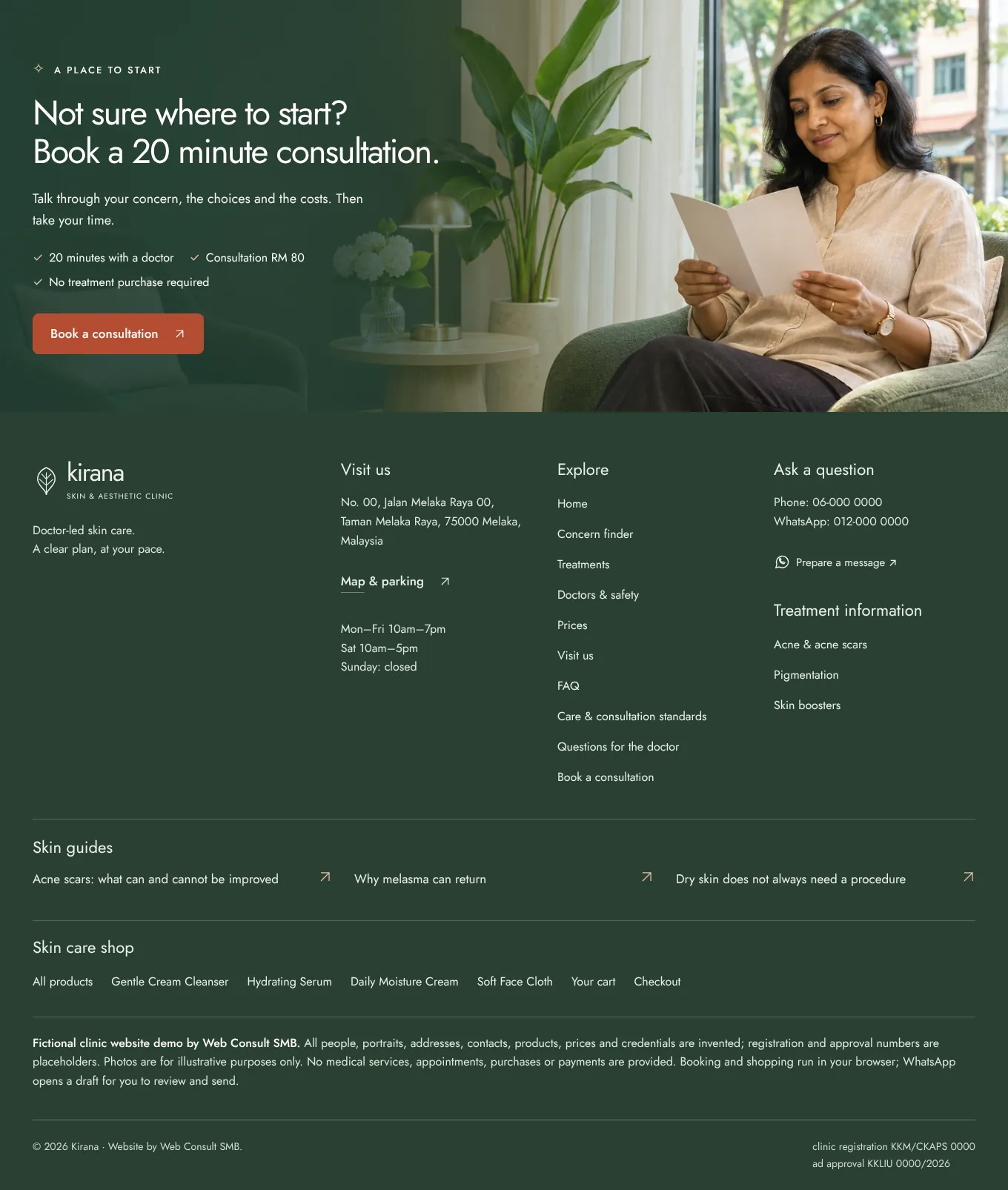
The ask + footer
End with an easy ask, and the details the rules need
“Not sure where to start? Book a 20 minute consultation.” The footer then repeats the address, hours and phone, and carries the clinic registration number, the advertising approval number (KKLIU) and “Photos are for illustrative purposes only.”
Clinic tipUse the same clinic name, address and phone as your Google listing, and keep the KKLIU number up to date.
Page 2 · Where people find their fit
The concern finder
For the visitor who knows their worry but not the treatment. It turns a menu of procedures into three simple questions, and hands the answer to the booking form.
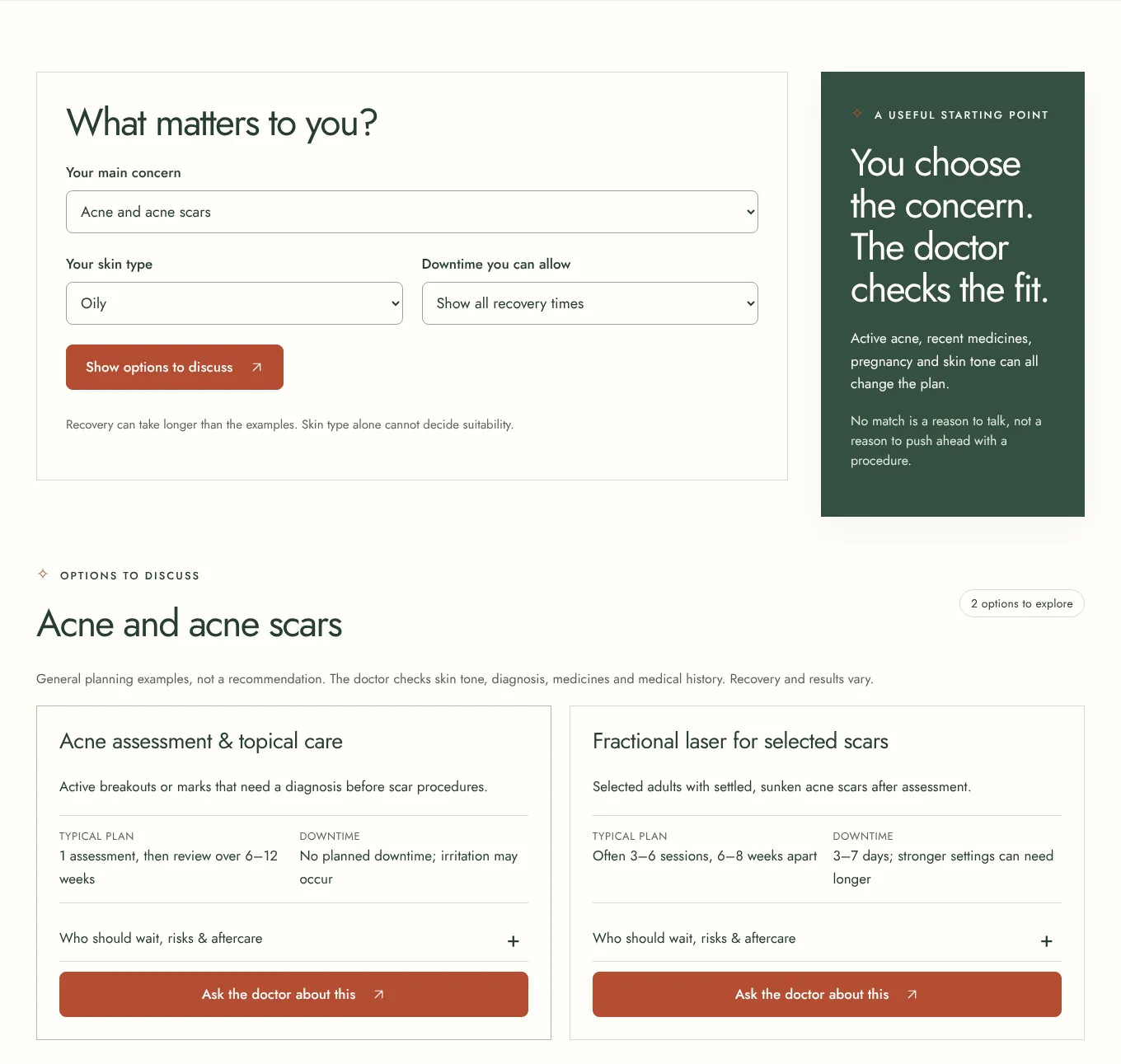
Filters
Ask three things they already know
Main concern, skin type and how much downtime they can allow. Nobody needs to know treatment names. The side panel says it plainly: “You choose the concern. The doctor checks the fit.”
Options
Call them options to discuss, not recommendations
“General planning examples, not a recommendation.” Each option shows the typical plan and downtime, with who should wait, risks and aftercare folded underneath. That keeps it honest and inside the rules.
Ask the doctor
Carry their choice into the booking form
“Ask the doctor about this” opens the booking page with the concern already chosen. One less step, and the doctor sees what they were reading about.
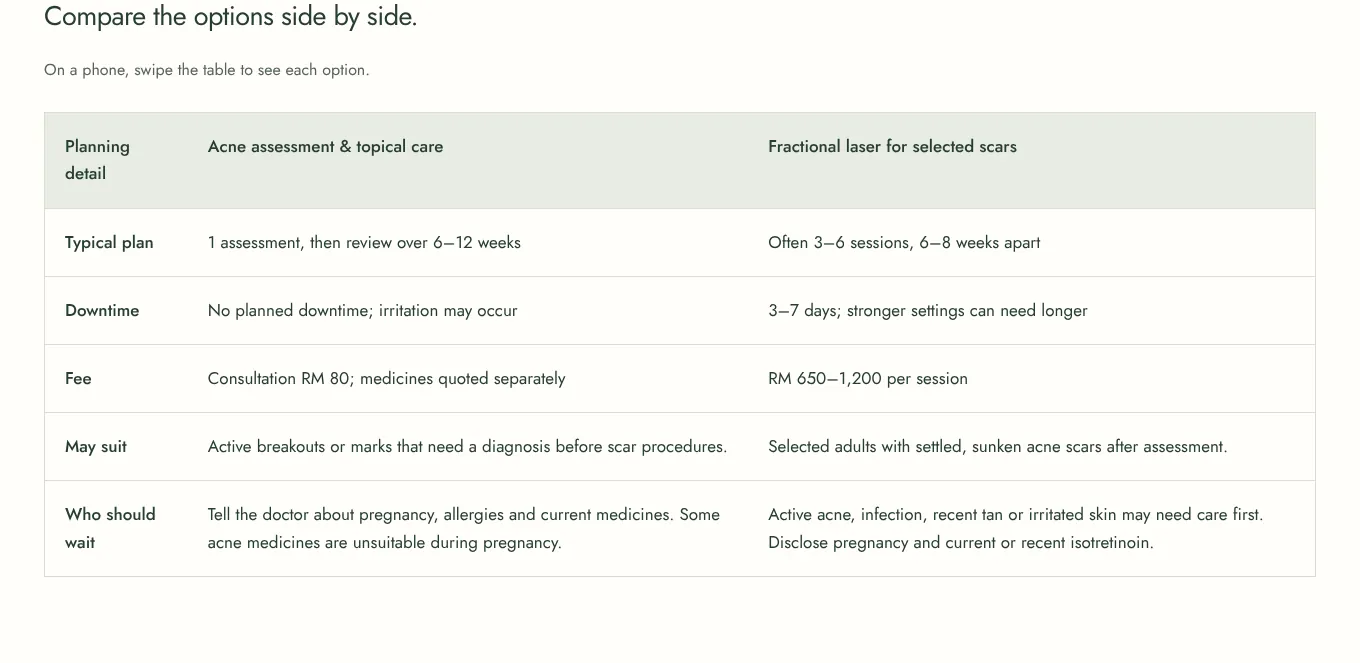
Compare
Put the options side by side
Typical plan, downtime, fee, who it may suit and who should wait, in one table. It answers the “which one is for me?” question that usually turns into ten WhatsApp messages.
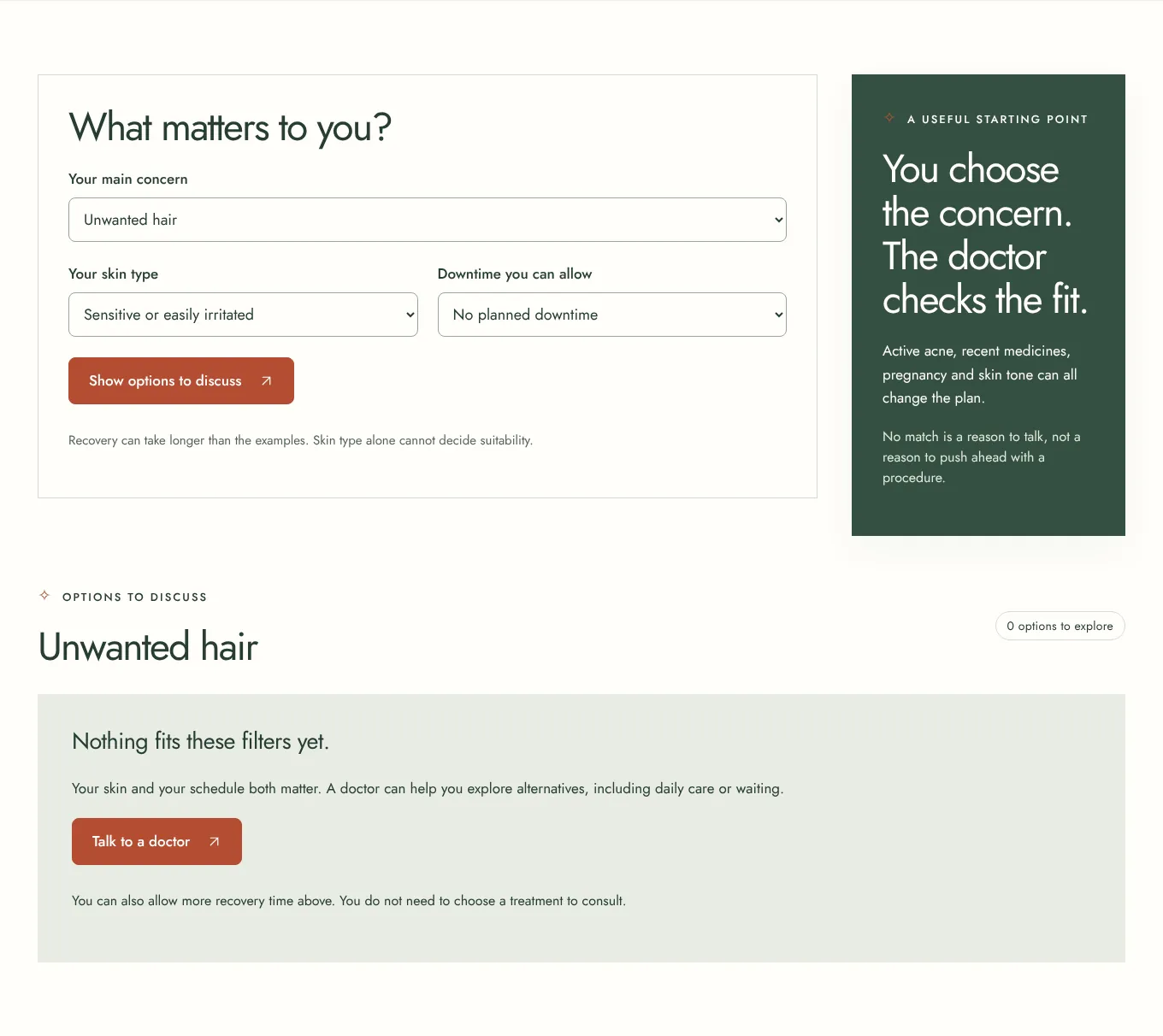
No match
Turn “nothing fits” into a conversation
Unwanted hair, sensitive skin, no downtime: nothing fits. Instead of an empty page, it says so kindly and offers “Talk to a doctor”. A dead end loses the person. A friendly next step keeps them.
Page 3 · Where people decide if it’s for them
A treatment page
Every concern tile leads to a page like this. Its job is to explain one treatment so honestly that the visitor trusts the clinic with the consultation.
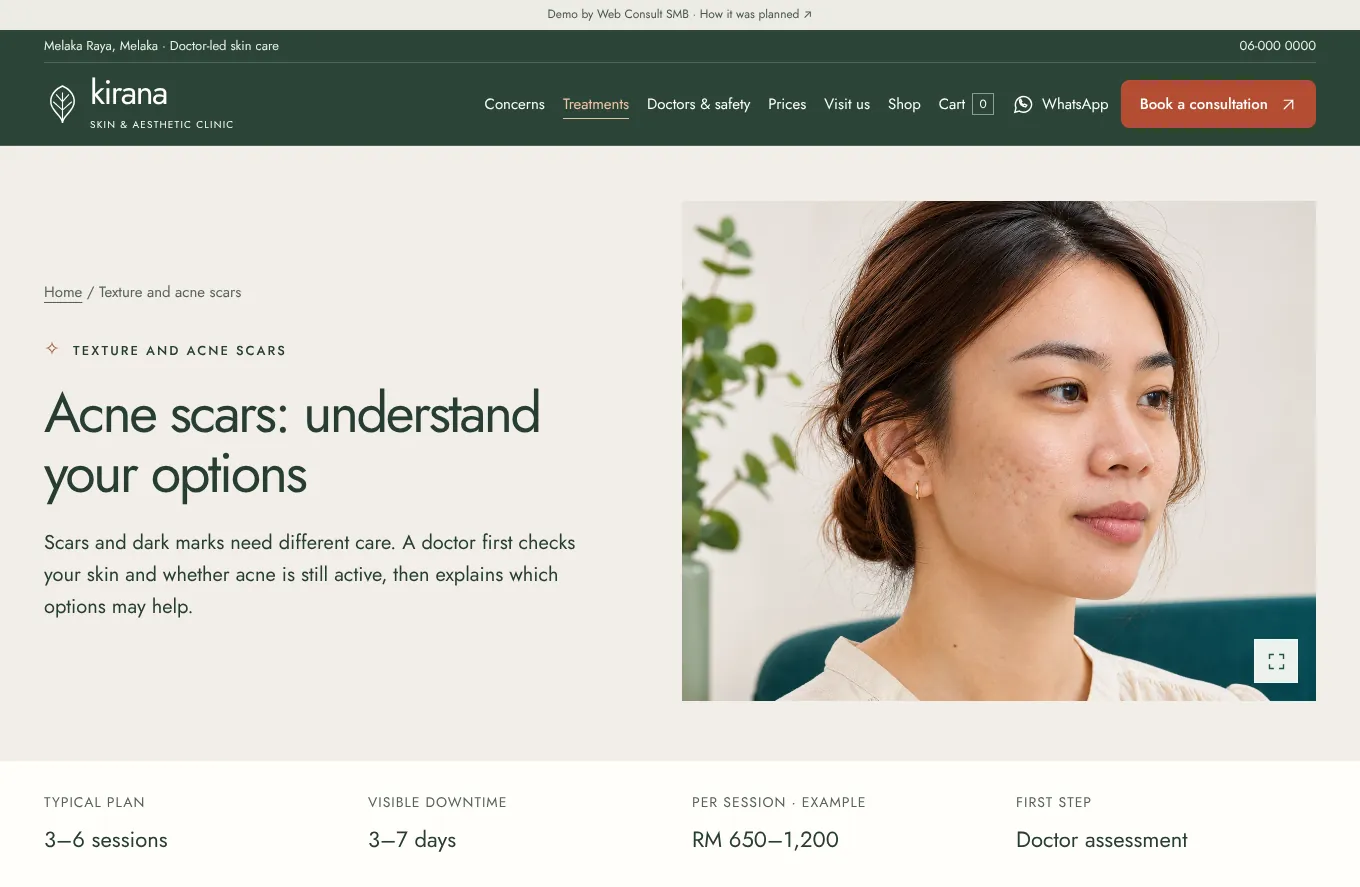
At a glance
Four facts before the first paragraph
Typical plan: 3 to 6 sessions. Visible downtime: 3 to 7 days. Per session: RM 650 to 1,200, as an example. First step: doctor assessment. Most people decide whether to read on from this strip alone.
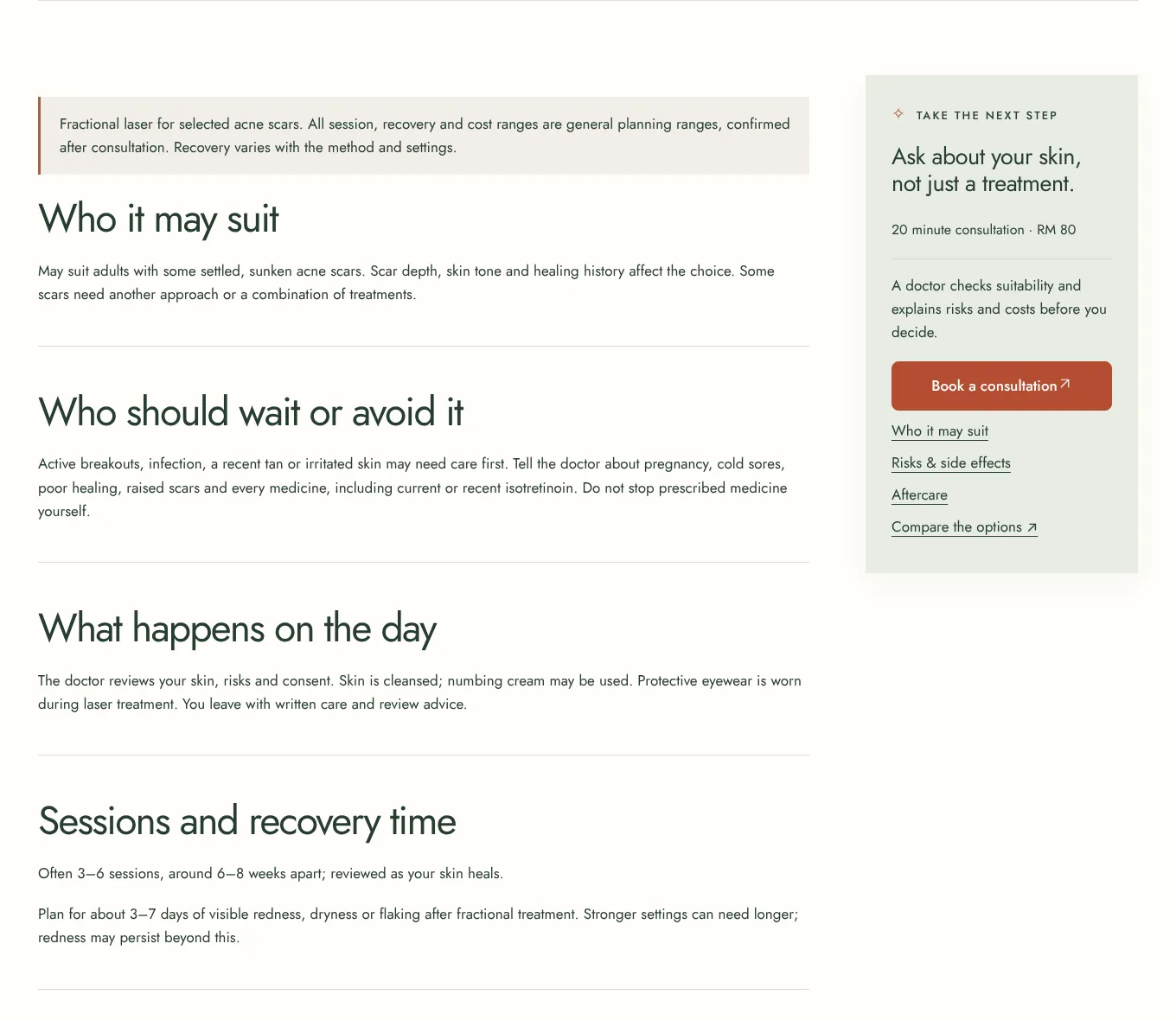
Who should wait
Say who it isn’t for
Active breakouts, infection, a recent tan, pregnancy, cold sores, raised scars, some medicines. Saying who should wait sounds like a doctor talking, not a salesperson, and that is what makes people trust the rest.
The day + sessions
Describe the day and the recovery in plain words
Numbing cream, eyewear, written aftercare. Often 3 to 6 sessions about 6 to 8 weeks apart, with redness or flaking for a few days. People plan their lives around this, so give them the shape of it.
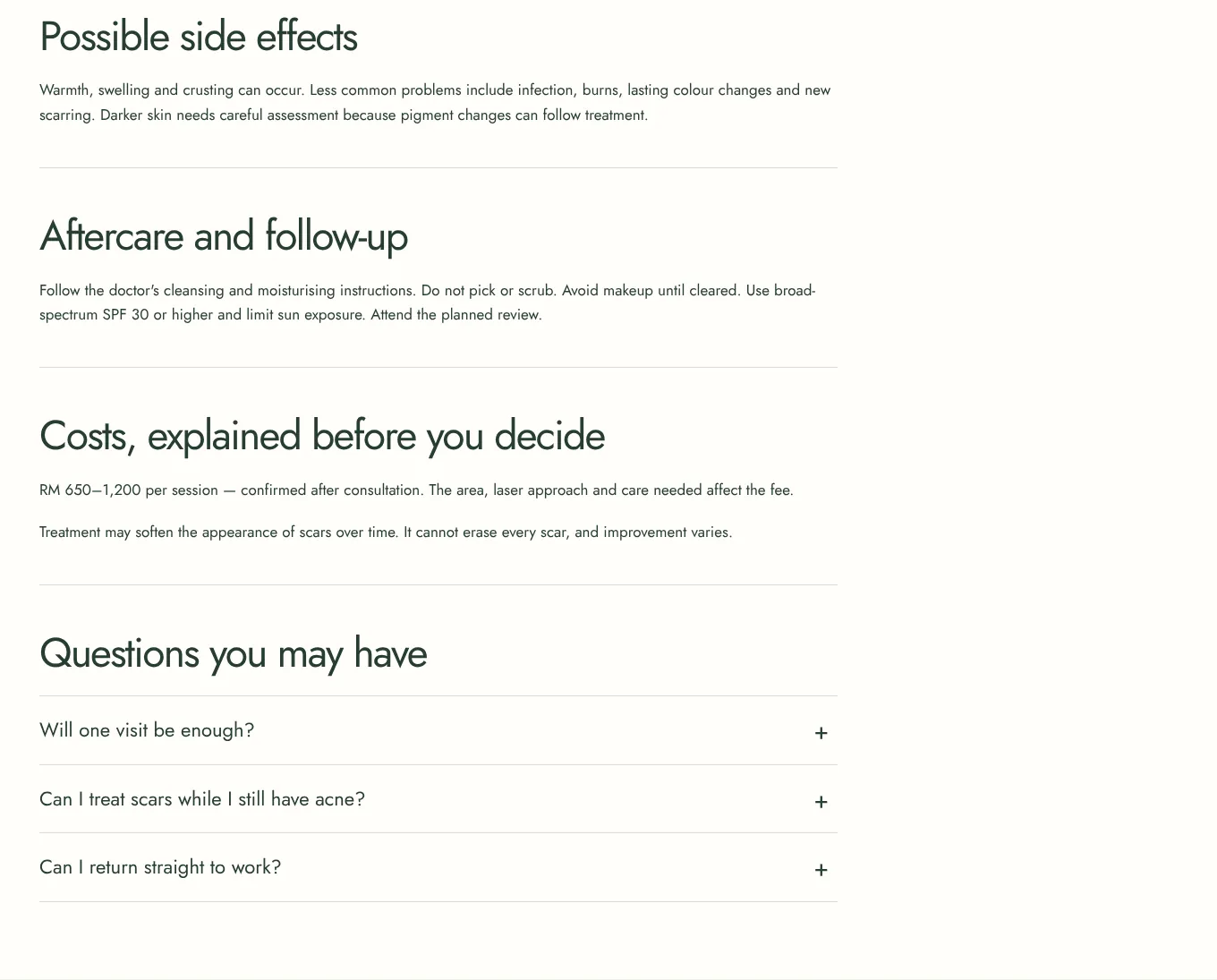
Side effects
List the side effects, including the rare ones
Warmth, swelling and crusting are common. Infection, burns, lasting colour changes and new scarring are less common. Darker skin needs careful assessment. It feels brave to write, and it is what a careful patient is looking for.
Cost + limits
Give a cost range and the limits of the treatment
“RM 650 to 1,200 per session, confirmed after consultation.” Then: “Treatment may soften the appearance of scars over time. It cannot erase every scar.” No guarantee, no “permanent”, no “painless”.
Clinic tipNever promise a result on a clinic website. “May soften”, “can improve” and “the doctor will explain what is realistic” are the words to use.
Page 4 · Where the consultation is booked
The booking flow
Every “Book a consultation” button leads here. It needs to feel as calm as the clinic, and work just as well on a phone.
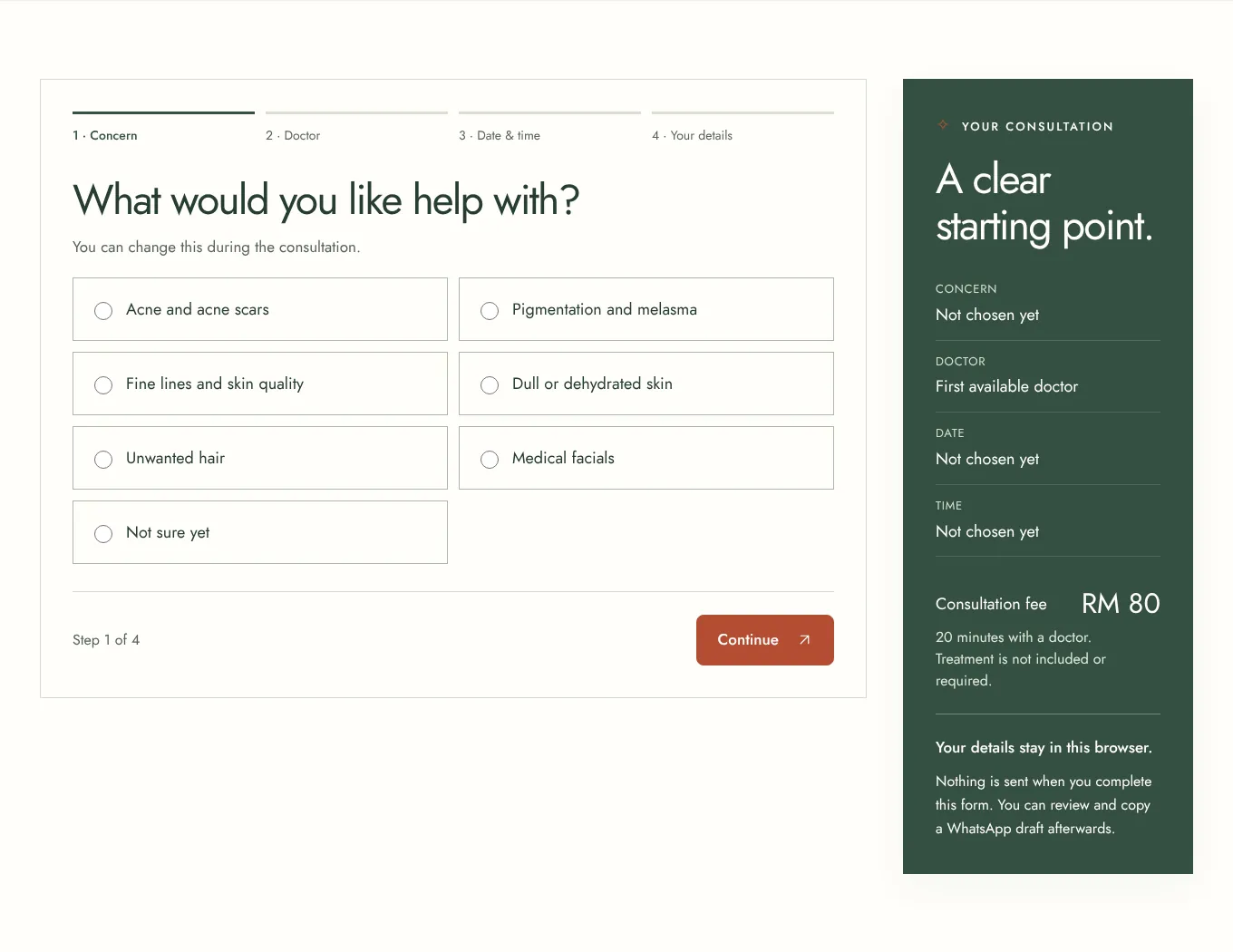
Steps + summary
Four short steps, with a live summary beside them
Concern, doctor, date and time, details. The dark panel fills in as they go and shows the RM 80 fee from the start. Nothing is a surprise at the end.
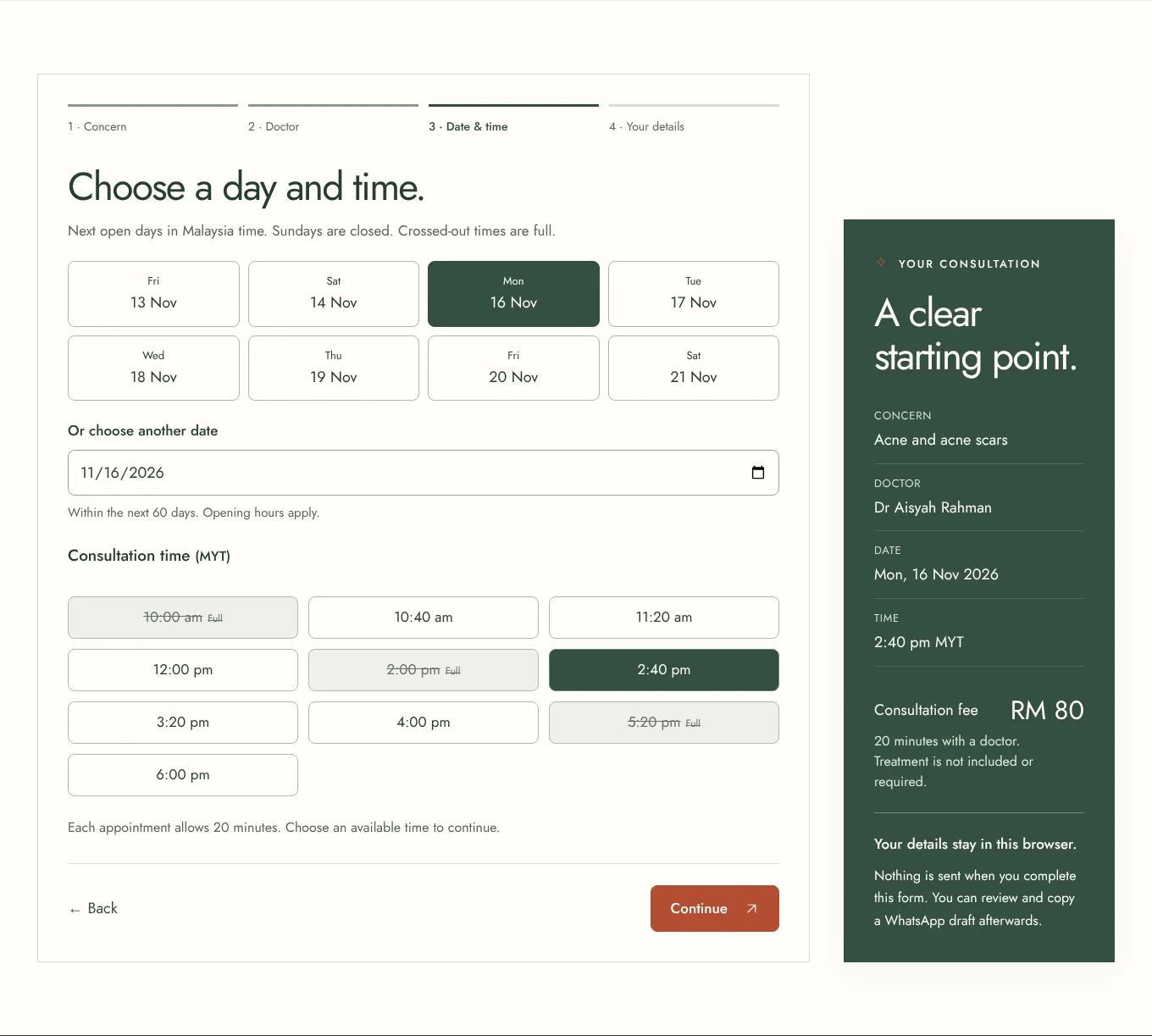
Date + time
Show real open days, and cross out the full slots
The next eight open days as big buttons, then times with the full ones crossed out. Seeing that some slots are taken quietly tells people the clinic is real and busy.
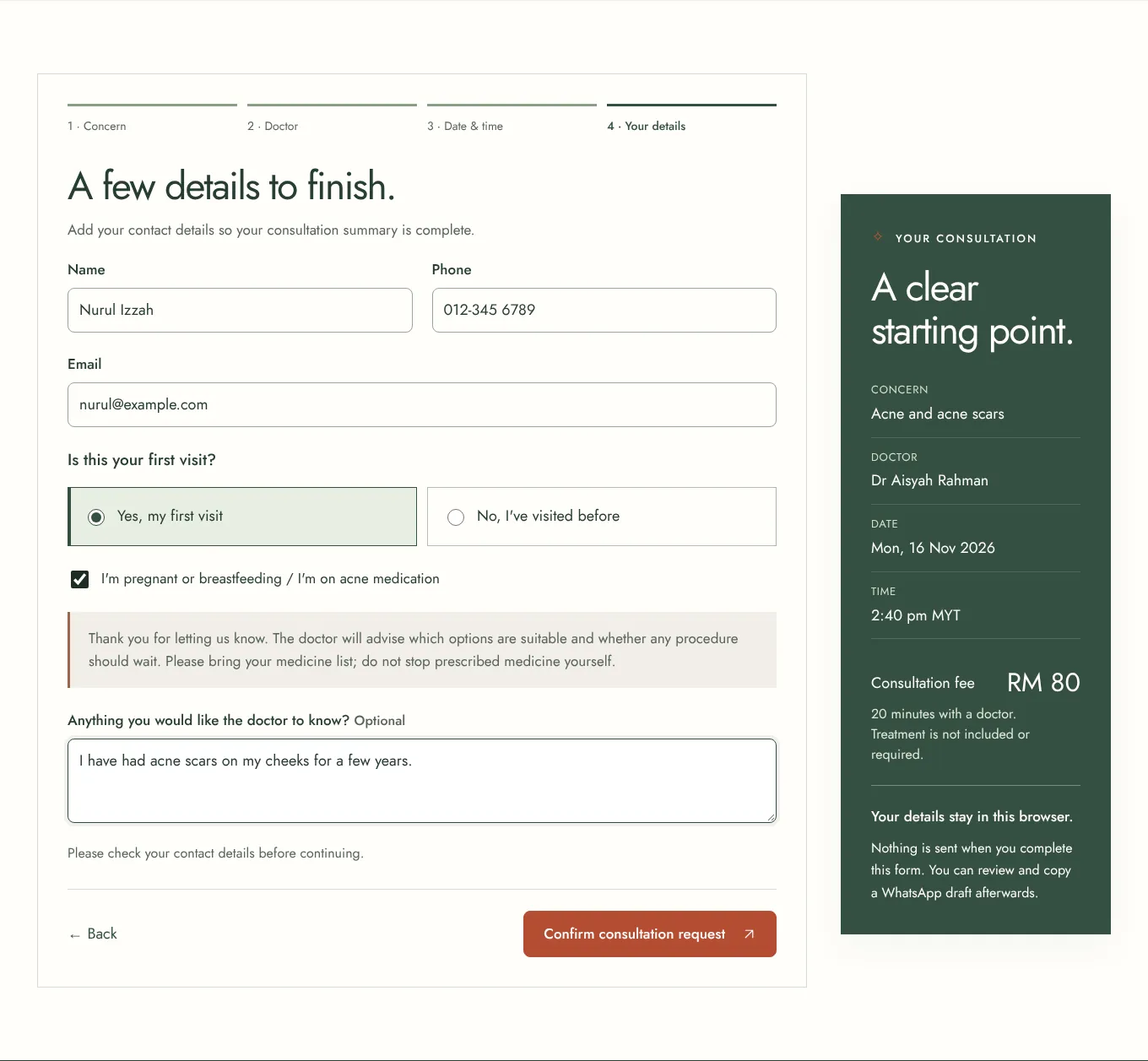
Health note
Ask the safety question gently
One tickbox: “I’m pregnant or breastfeeding / I’m on acne medicine.” When ticked, a calm note says the doctor will advise which options are suitable. It catches the cases that need care, without a scary medical form.
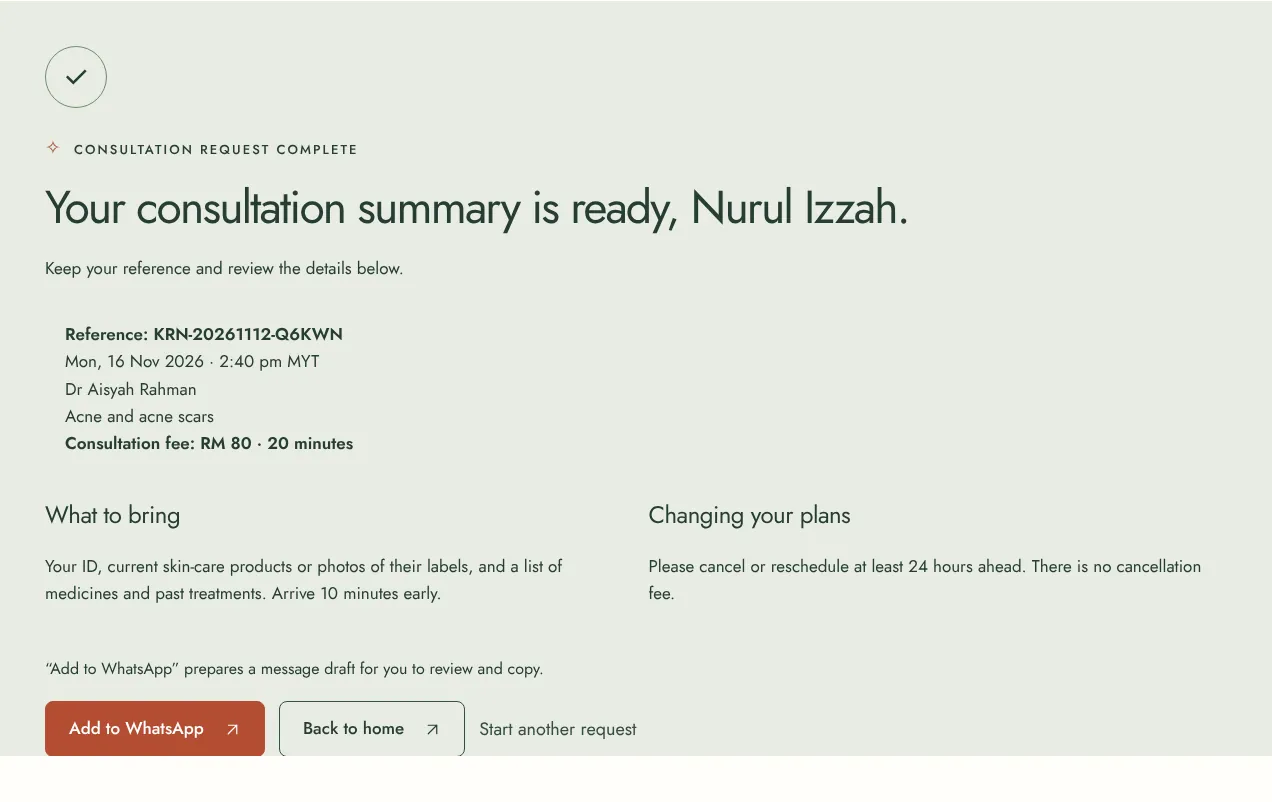
Confirmation
Confirm with a reference, what to bring and the change policy
Reference number, doctor, date, time and fee. Then what to bring (products you use, a list of medicines) and how to change the booking. “Add to WhatsApp” sends it to the clinic in one tap.
Clinic tipReply on WhatsApp within the hour during opening times. For a nervous first timer, a quick human “See you on Monday” matters more than any design.
Page 5 · Where trust is checked
The doctors and safety page
Careful patients, and their worried family members, open this page before they book anything. It should read like a clinic that is happy to be checked.
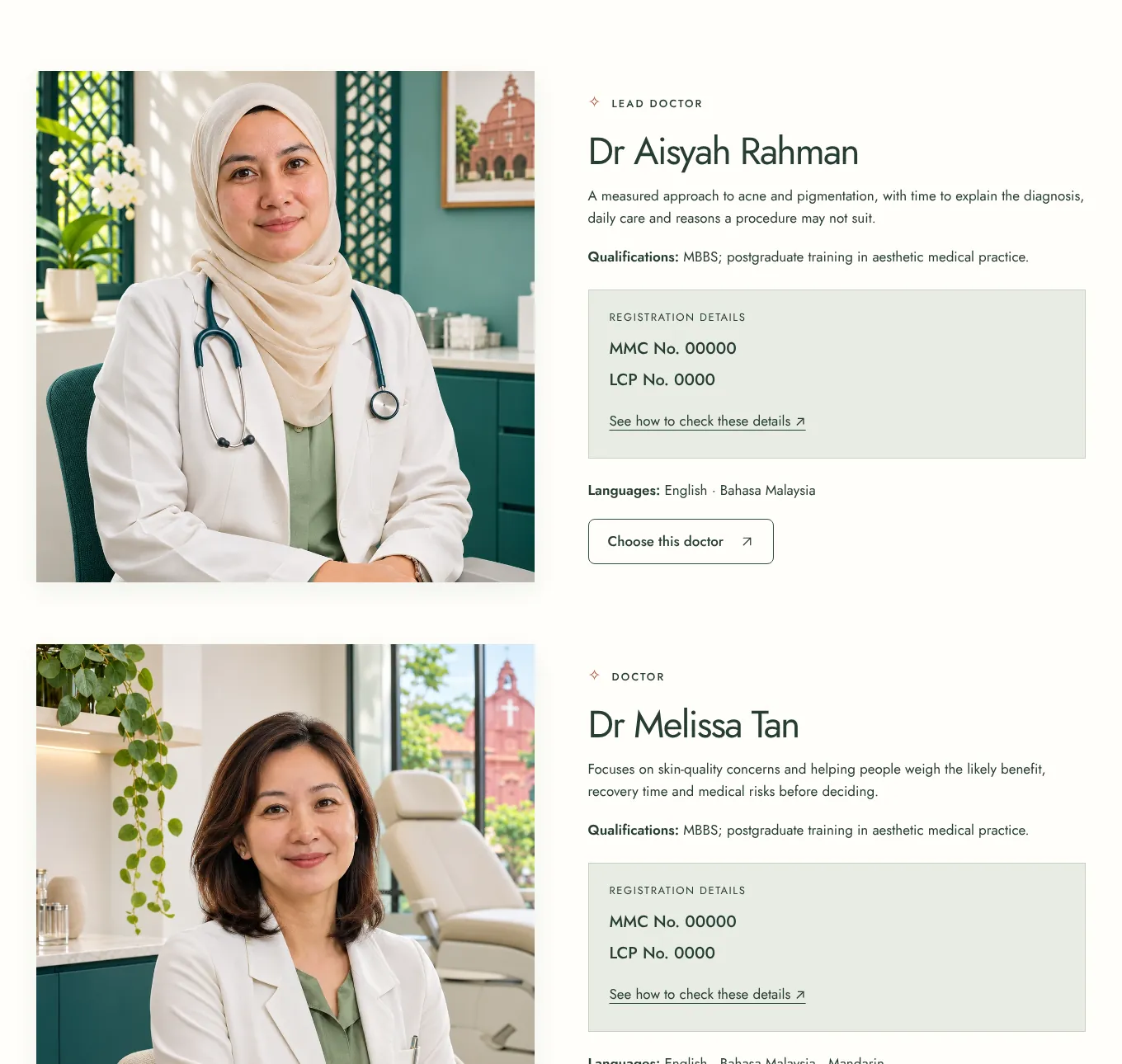
Credentials
Show every number, and how to check it
Each doctor has a box with the MMC number, the LCP number and a link explaining how to check them. A note reminds visitors to check the current Annual Practising Certificate and the procedures the LCP covers.
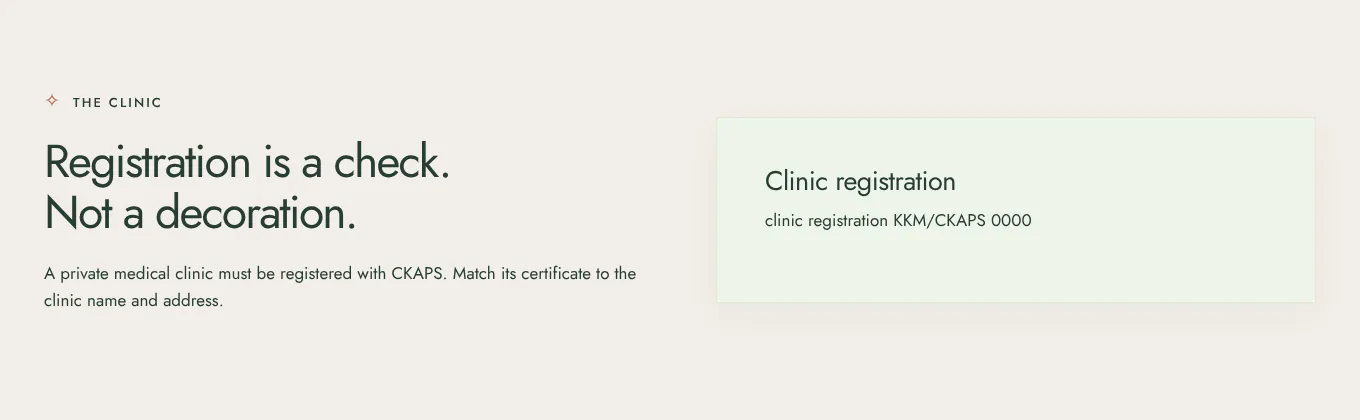
Registration
Treat the clinic licence as something to check
“Registration is a check. Not a decoration.” The registration number, and a link to the Ministry of Health’s list of registered private clinics.
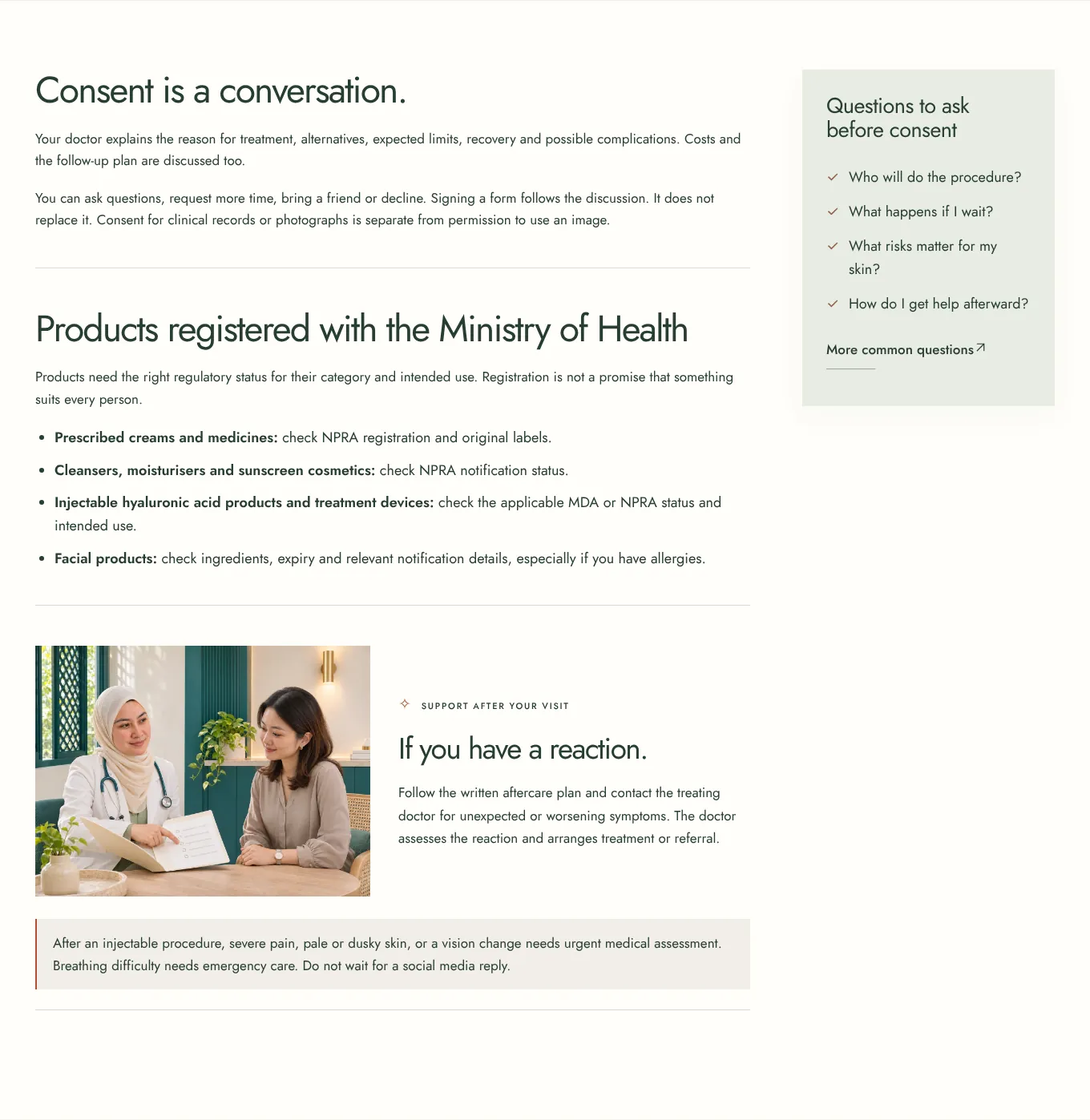
Consent + products
Explain consent and product checks in plain words
Consent is a conversation, with time to ask questions and the right to say no. Then how each kind of product is checked: prescription creams, cosmetics, injectable products and devices.
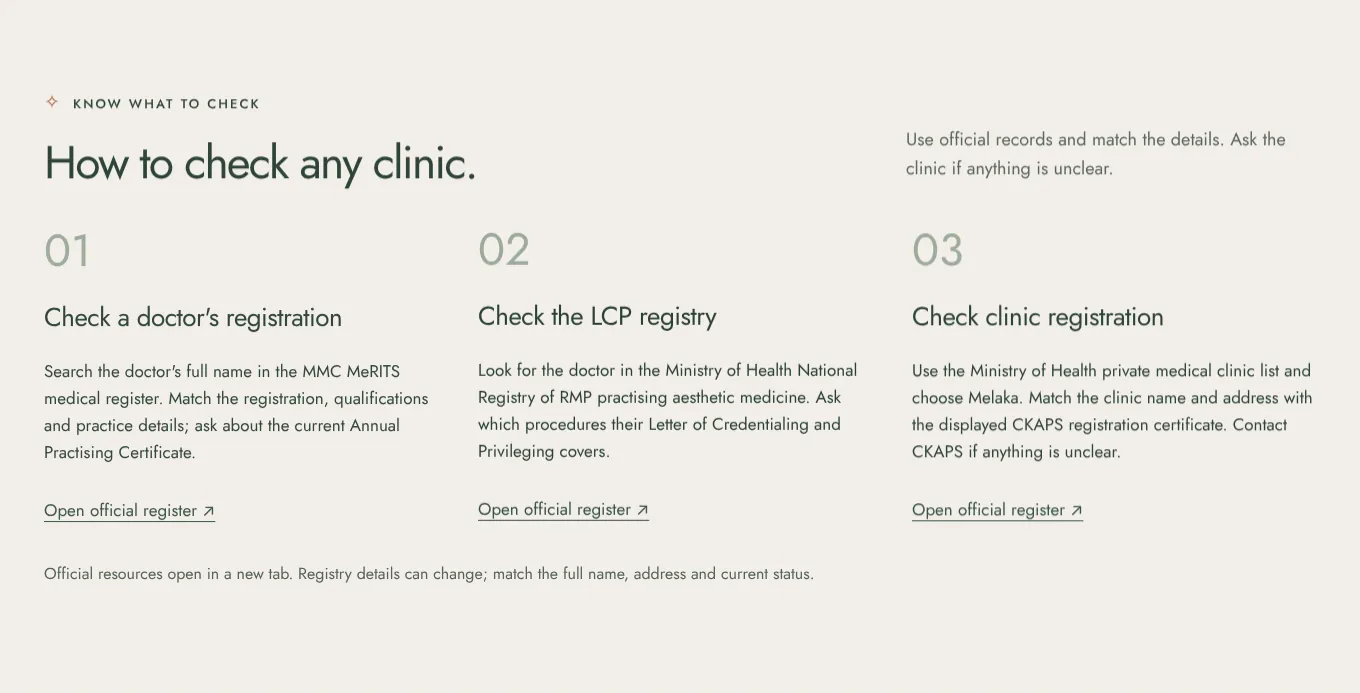
Check any clinic
Teach people how to check any clinic, even yours
Three steps with links to the official registers: the doctor, the LCP and the clinic. It is useful even to someone who goes elsewhere, and that generosity is exactly why they come back.
On a phone
The same site on a phone
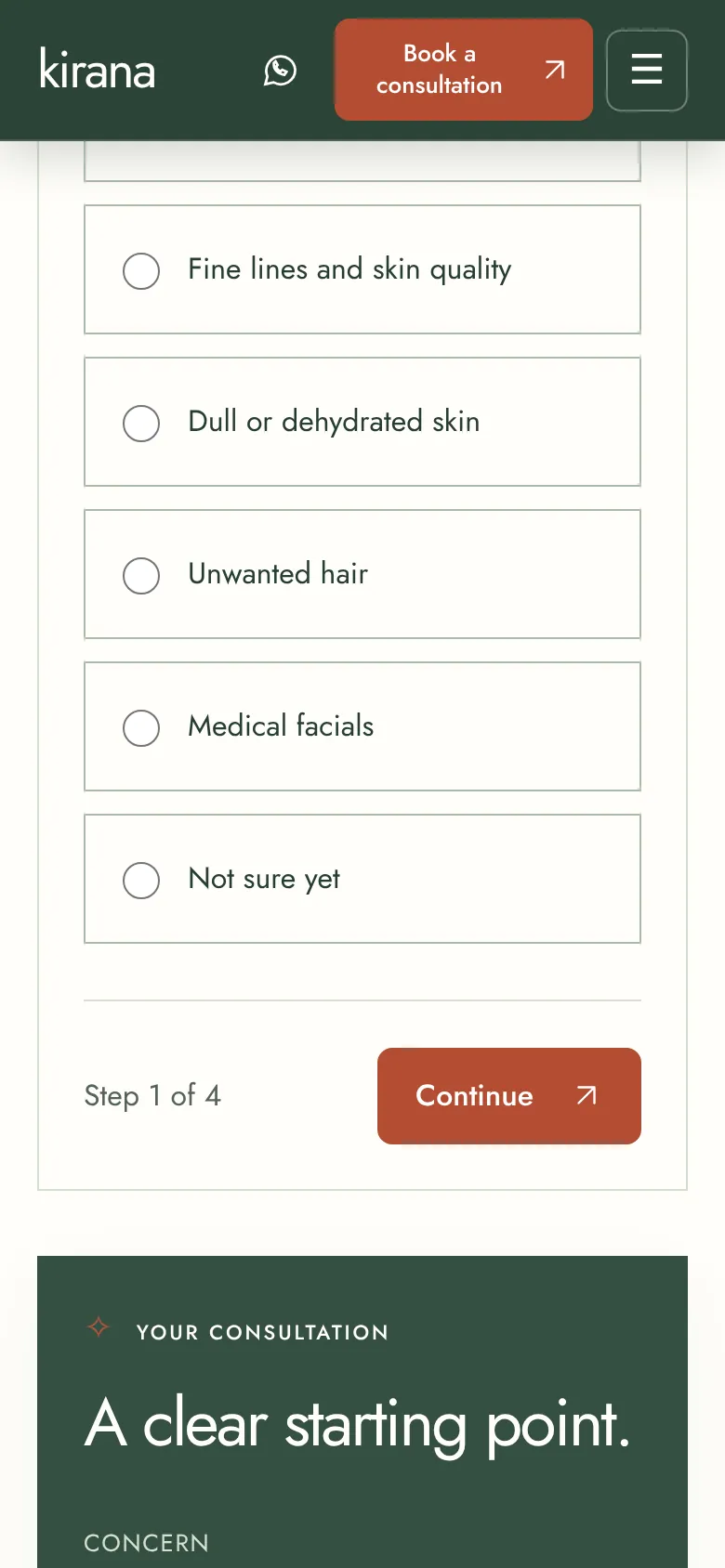
Two screens from the demo: the homepage and the booking form, at the size most people first see them.
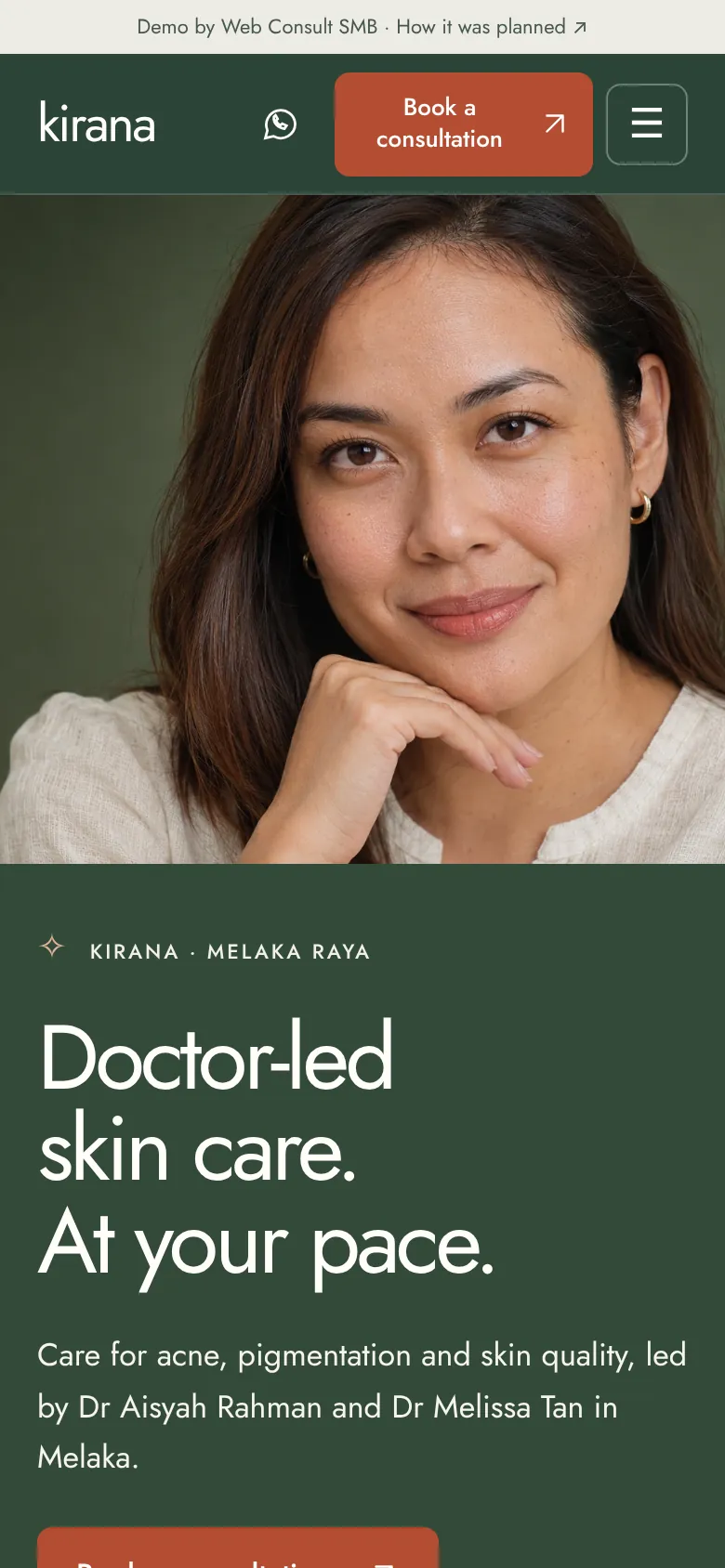
Header
The booking button never leaves the screen
On a phone the menu folds away, but “Book a consultation” and WhatsApp stay in the header, one tap away on every page.
Form
Big choices, one per line
Each concern is a full width button, easy for a thumb. The phone and email fields open the right keyboard, and the dates are large buttons rather than a tiny calendar.
Why it matters
Most people look at skin clinics on their phone
Often late at night, after scrolling past an ad or a friend’s post. If booking works there, they book there.
Clinic tipOpen your own clinic site on your phone and try to book. If it takes more than two minutes, start there.
Page 6 · A small shop on the side
The skincare shop
Selling aftercare products can add steady income between treatments. Keep it simple, and keep it clearly apart from the medical side.
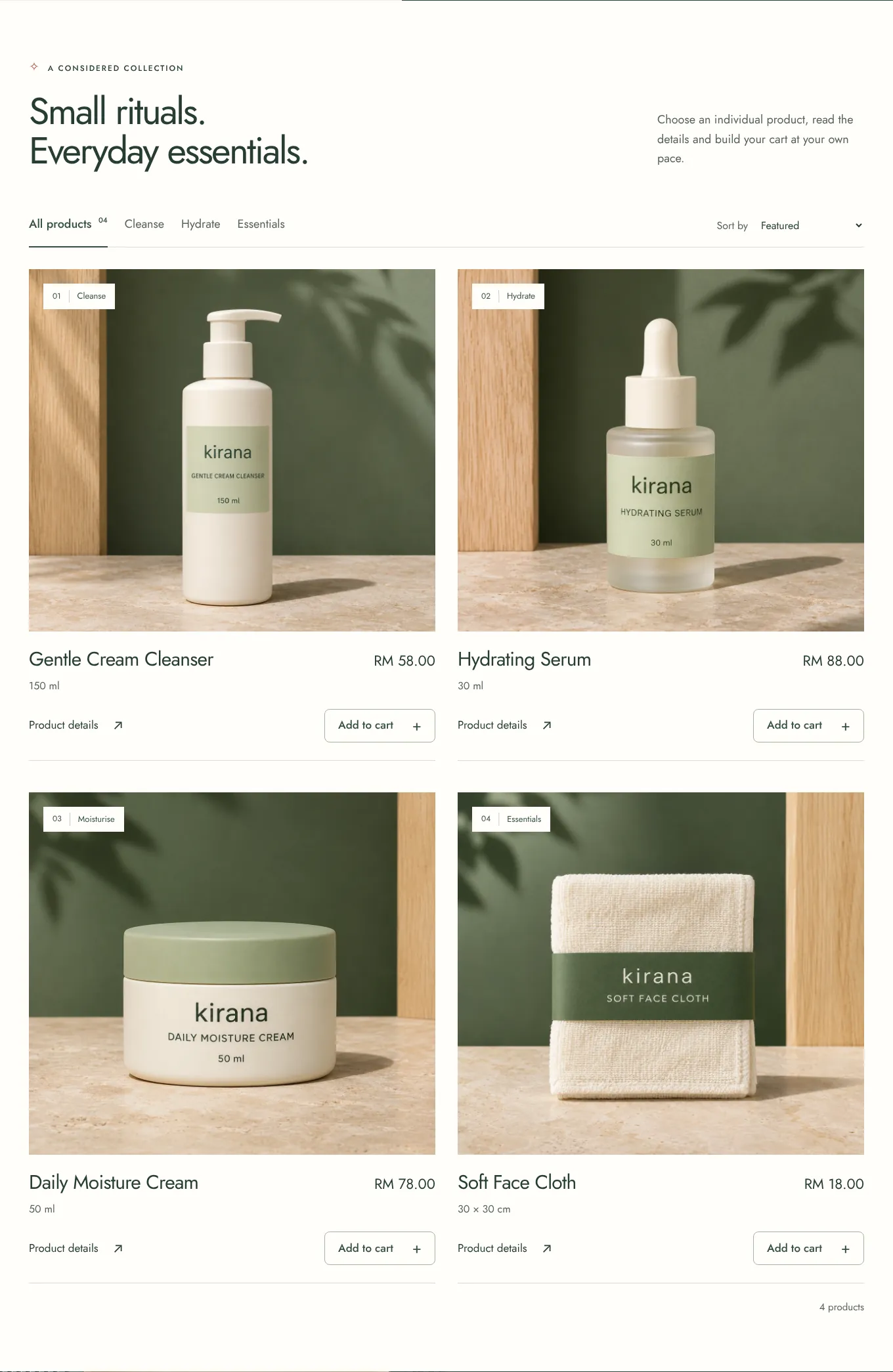
Collection
Sell everyday skincare, not treatments
A cleanser, a serum, a cream and a face cloth, each with its size and price. Filters by type and a sort. Treatments and prescription products stay with the doctor, never in a cart.
Clinic tipEvery cosmetic you sell should carry its NPRA notification. Keep the product claims to what the notification allows.
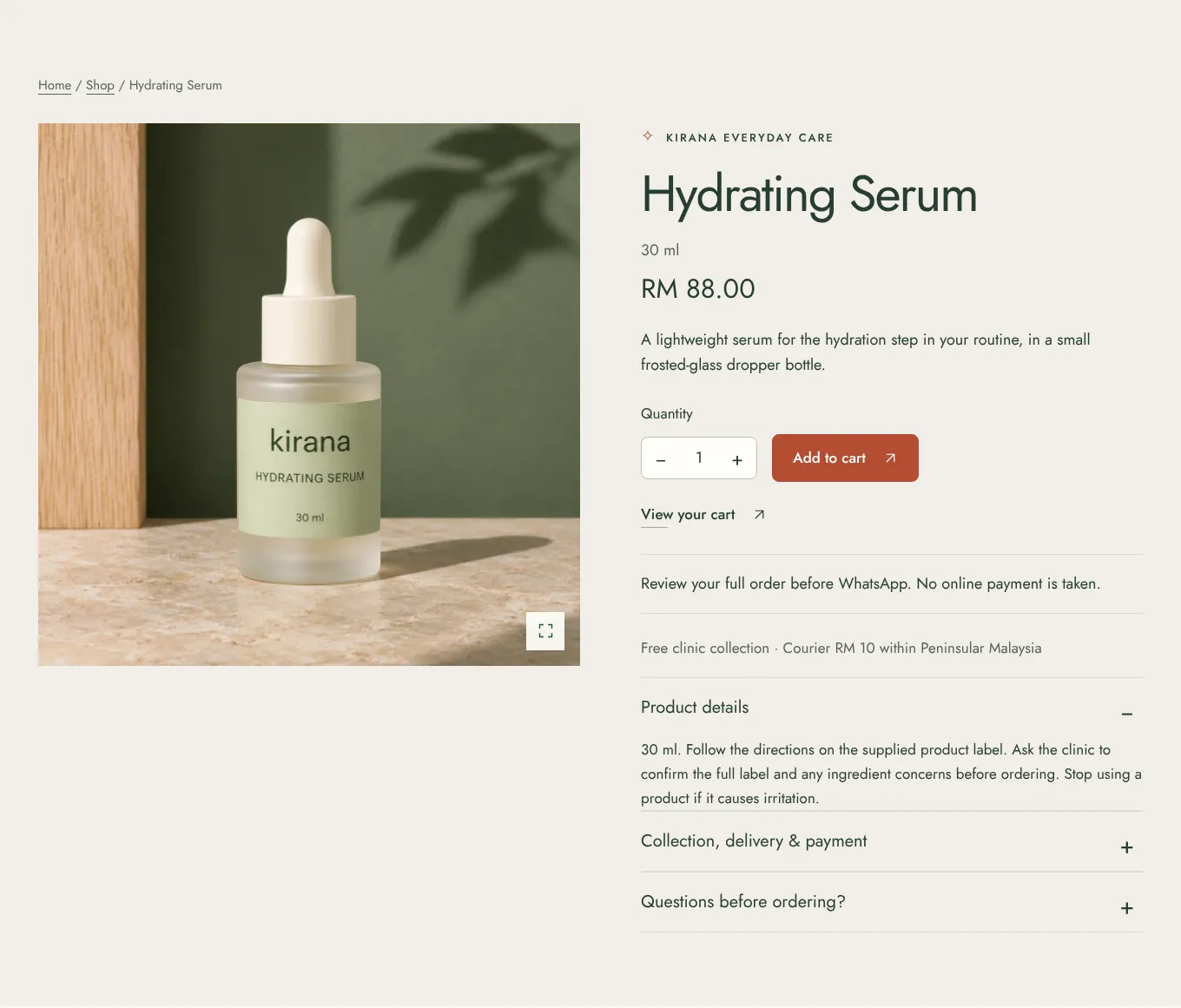
Product page
Size, price, how to use, and who it suits
One photo, the size, the price and the quantity. Then how to use it, collection or courier, and questions folded underneath. A product page is the one place a clinic can sell plainly.
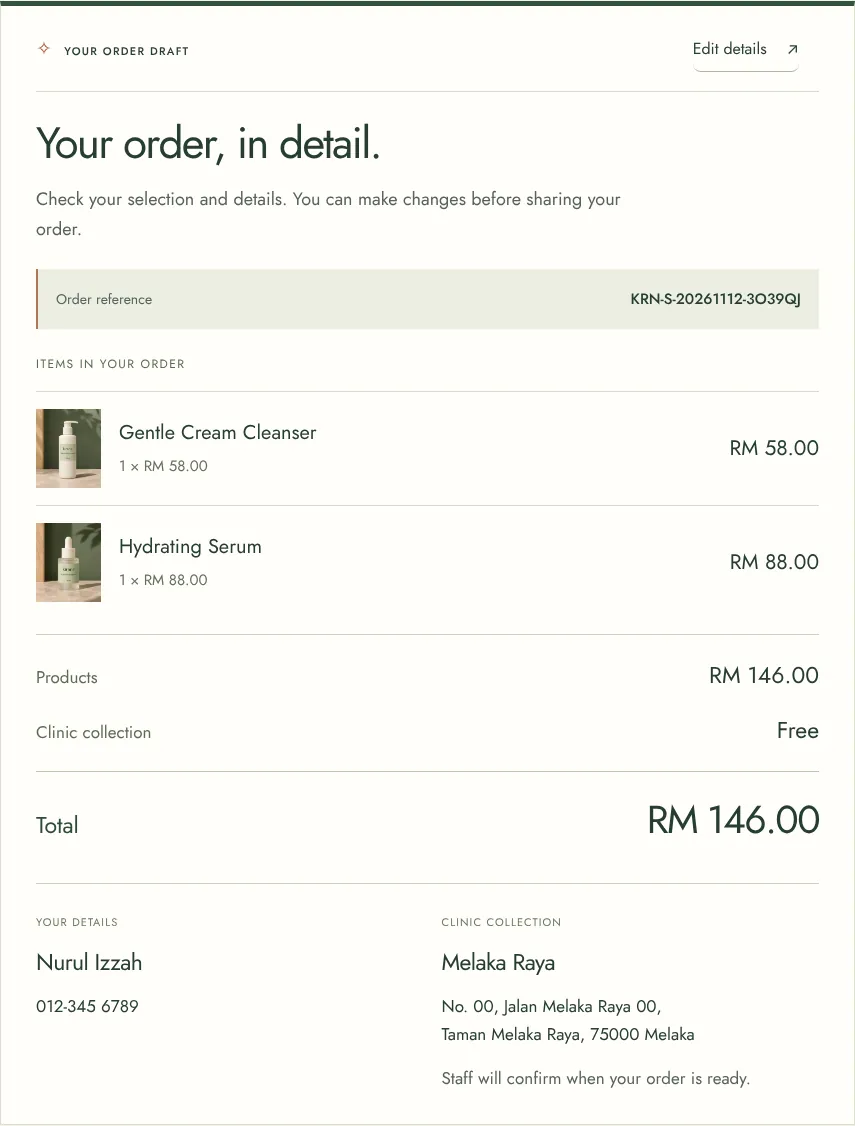
Checkout
Check out on WhatsApp, with a reference number
No payment gateway needed to start. The order review shows a reference, the items, collection or courier and the total. One tap opens WhatsApp with it all written out, and the staff confirm.
Advertising rules
The rules every Malaysian clinic website has to follow
This is what changes most for clinics compared with other businesses. I have kept the demo inside these rules. This is a plain summary, not legal advice: check the current guidelines, or ask the board, before you publish. Checked 12 Nov 2026.
Aesthetic treatment is medical treatment
It has to be done by a registered doctor, in a licensed or registered clinic. For aesthetic procedures the doctor also needs a Letter of Credentialing and Privileging (LCP) that covers that procedure.
Your website needs approval too
Only registered clinics may advertise, and the advertisement needs approval from the Medicine Advertisements Board, which gives a KKLIU number. The Medical Council’s guideline says website content must be submitted for prior approval.
Source: KKM Pharmacy Division FAQ · MMC guideline V2/2025, 4.17.3
No before and after pictures
The board’s policy says an advertisement should not contain “before” and “after” pictures. That is why the demo uses a week by week timeline instead.
Source: MAB policy 2/2019
No real patients receiving treatment
Ads may not use patients receiving treatment. Models or actors are allowed with the line “This image/video is for illustrative purposes only.”
Source: MAB policy 12/2007
No praise, no “best”
Website information must be “informative and simple, without laudatory remarks”, and claiming to be the best or the only one is unethical. Testimonials and review widgets fall into the same trap, so keep reviews on Google.
No selling on price
Doctors must not publicise services on financial grounds, and the guideline warns about discounted rates. So no promotions, packages or “limited slots”. A plain consultation fee and price ranges are fine.
Also worth reading: the Ministry of Health’s Guidelines on Aesthetic Medical Practice. If you are not sure whether something on your site needs approval, ask before it goes live.
The other pages
What each of the other pages must do
These support the pages above. Keep each one focused on a single job.
Prices
The consultation fee, then each treatment as a price per session with typical sessions, and what changes the cost. No packages, no promotions. Example →
Visit us
A photo of the shopfront, a map, hours with a live open or closed status, parking, and the small things: women doctors, a prayer room nearby. Example →
FAQ
Ten plain answers: pain, downtime, makeup after, halal questions, payment, bringing a friend. Example →
Treatment pages
One page for each concern, like the acne scars page above: pigmentation and skin boosters in the demo. Example →
Skin guides
Full educational articles with contents and sources, each ending with an invitation to a consultation. Example →
Shop and product pages
A product grid, one page per product, a cart and a WhatsApp checkout. Example →
Beyond the pages
Six things that quietly bring in more bookings
Not pages, but they decide whether people find the clinic, and whether a booking turns into a visit.
Keep your Google listing complete
The right category, real photos of the clinic and the doctors, hours that match the website, and polite replies to every review. Reviews belong there. See Google Business Profile.
Reply on WhatsApp within the hour
A nervous first timer often sends one message and waits. A quick, kind answer turns a question into a booking. See WhatsApp for small business.
Reminders
Send a reminder the day before
A short WhatsApp with the time, the doctor and what to bring cuts no shows.
Tracking
Count every booking request
Set up a goal for each consultation request, so you can see which pages and concerns bring them in. See Google Analytics for small business.
Language
Offer Bahasa Malaysia and Chinese
At least the key pages: concerns, the booking form and the fee. Many patients will feel more at ease reading in their own language.
Approval
Check before you change the claims
New treatments, new wording, new photos: check whether the advertising board needs to see them before they go live.
What good looks like
Clinic website checklist
Check your own site against these. Each one you are missing is a reason for someone to keep scrolling, or a risk with the regulators.
Who leads the care, in the hero
Named doctors and the town, plus the consultation fee.
“Book a consultation” in the header
With WhatsApp beside it, on every page.
Concerns in plain words
Acne scars, melasma, fine lines, not machine names.
Doctors with MMC and LCP numbers
And a link showing how to check them.
Sessions, downtime and side effects
On every treatment, including who should wait.
A fixed consultation fee
And price ranges per session, with no promotions.
A short booking flow
Concern, doctor, real time slots, a gentle health question.
A safety page
Registration, consent, product checks and how to check any clinic.
KKLIU and registration numbers in the footer
Plus “Photos are for illustrative purposes only”.
Four things that put clinics at risk
Before and after photos or sliders
Not allowed in clinic advertising. Use a plain “what to expect” timeline.
Patient testimonials and review widgets
Leave reviews on Google, and let the doctors answer questions instead.
Promotions, packages and “limited slots”
Selling on price is what the guidelines warn against, and it scares careful patients away.
“Best”, “painless”, “permanent”, “guaranteed”
Claims like these break the rules and break trust. Say what is typical, and that the doctor confirms it.
Owners’ questions
Clinic website questions
What should an aesthetic clinic website include?
A first screen that says which doctors lead the care and where, a Book a consultation button in the header, concerns in plain words, doctor profiles with MMC and LCP numbers, a page for each treatment with sessions, downtime, side effects and who should wait, a fixed consultation fee, a short booking flow, a safety page, and the clinic registration and KKLIU approval numbers in the footer.
Can a clinic in Malaysia show before and after photos on its website?
No. The Medicine Advertisements Board policy says an advertisement should not contain before and after pictures, and a clinic website counts as advertising. A plain timeline of what happens at the consultation, on the day, in the first week and at the review does the same job without breaking the rule.
Can a clinic put patient reviews or testimonials on its website?
It is safer not to. The Medical Council guideline asks for information that is informative and simple, without laudatory remarks, and says self promotion is not appropriate online. Let reviews live on your Google listing, reply to them politely, and use short doctor answers to common questions on the website instead.
Does a clinic website need KKLIU approval?
Yes. Only registered clinics may advertise, the advertisement needs approval from the Medicine Advertisements Board, and the Medical Council guideline says website content must be submitted for prior approval. Plan the approval time into your launch date, and show the KKLIU number on the site.
How much does a clinic website cost in Malaysia?
A 5 to 10 page site built to bring in enquiries usually costs RM 6,000 to RM 15,000 in Malaysia in 2026. A clinic site with a concern finder, a booking flow, treatment pages and a small shop sits at the top of that range or above. See the full price guide for what changes the quote. Website design cost in Malaysia →
Run a clinic or a beauty business? Let’s fill your consultation book.
Whether you have a website or not, there’s a next step for you.
Already have a website
Send me your website
I’ll check it against this page, including the advertising rules, and send the three changes that would bring you the most bookings, within 48 hours. Free, no sales call.
No website yet, or starting over
Get a clinic site built like this
Doctor profiles, honest treatment pages, a concern finder and a booking flow, built around your own team and photos, and written to suit the advertising rules.
More industries: website concepts by industry → · manufacturing walkthrough · restaurant walkthrough · property agent walkthrough · lawyer walkthrough · bakery walkthrough